Passive transport
Passive transport is a type of cellular transport that does not require energy to move substances across cell membranes. It is a naturally occurring phenomenon and relies on the inherent kinetic energy and natural entropy of molecules to diffuse across a membrane.
Types of Passive Transport[edit]
There are three main types of passive transport:
- Simple diffusion: This is the process by which solutes are moved along a concentration gradient in a solution or across a semipermeable membrane.
- Facilitated diffusion: This process uses transport proteins to move other ions and small molecules across the cell membrane.
- Osmosis: This is the movement of solvent molecules through a selectively permeable membrane into an area of higher solute concentration, aiming to equalize the solute concentrations on the two sides.
Factors Affecting Passive Transport[edit]
Several factors can affect the rate of passive transport, including:
- Temperature: Higher temperatures increase the energy and therefore the movement of the molecules, increasing the rate of diffusion.
- Concentration gradient: The greater the difference in concentration, the quicker the diffusion takes place.
- Size of the molecules: Smaller molecules diffuse more quickly than larger ones because smaller molecules move faster due to having less mass.
- Nature of the molecules: Polar molecules diffuse more slowly than non-polar molecules. Non-polar or lipid-soluble molecules pass through the membrane more easily than polar molecules.
Importance of Passive Transport[edit]
Passive transport is essential for many functions within the human body and in other living organisms. For example, it is necessary for the absorption of most of the water and nutrients cells need. It also helps to maintain the balance of various ions (both inside and outside the cells) which is necessary for nerve and muscle function.

This WikiMD article can only be edited by registered and verified editors. You can log in or register.
-
Cellular diffusion
-
Simple diffusion in cell membrane
-
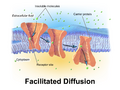 Facilitated diffusion
 -
Filtration diagram
-
 Osmotic pressure on blood cells


Sponsored Health Resource

W8MD Weight Loss, Sleep & MedSpa
Looking for physician-supervised weight loss, semaglutide, tirzepatide, or GLP-1 receptor agonist options? W8MD helps eligible patients in New York City, Brooklyn, New Jersey, Connecticut, Pennsylvania, Delaware, and greater Philadelphia with medical weight loss, sleep medicine, and long-term maintenance support.
GLP-1 specials: Affordable GLP-1 injections NYC and Philadelphia starting from $29.99/week and up for semaglutide with insurance accepted for qualifying visits, and $45/week and up for tirzepatide with insurance accepted for qualifying visits. Self-pay options start from $59.99/week and up for semaglutide and $69.99/week and up for tirzepatide.
- Medical weight loss NYC
- Affordable GLP-1 injections NYC
- Budget GLP-1 weight loss shots Philadelphia
- New Jersey medical weight loss
- NYC medical weight loss blog
- Philadelphia weight loss blog
- Sleep medicine and sleep apnea services
- W8MD MedSpa and wellness
Book a W8MD appointment · View GLP-1 specials
Paid promotional message. Eligibility, pricing, insurance coverage, medication availability, and results vary. Medical evaluation required.

Medical Disclaimer: WikiMD is for informational purposes only and is not a substitute for professional medical advice. Content may be inaccurate or outdated and should not be used for diagnosis or treatment. Always consult your healthcare provider for medical decisions. Verify information with trusted sources such as CDC.gov and NIH.gov. By using this site, you agree that WikiMD is not liable for any outcomes related to its content. See full disclaimer.
Credits:Most images are courtesy of Wikimedia commons, and templates, categories Wikipedia, licensed under CC BY SA or similar.
Translate page: - East Asian
中文,
日本,
한국어,
South Asian
हिन्दी,
தமிழ்,
తెలుగు,
Urdu,
ಕನ್ನಡ,
Southeast Asian
Indonesian,
Vietnamese,
Thai,
မြန်မာဘာသာ,
বাংলা
European
español,
Deutsch,
français,
Greek,
português do Brasil,
polski,
română,
русский,
Nederlands,
norsk,
svenska,
suomi,
Italian
Middle Eastern & African
عربى,
Turkish,
Persian,
Hebrew,
Afrikaans,
isiZulu,
Kiswahili,
Other
Bulgarian,
Hungarian,
Czech,
Swedish,
മലയാളം,
मराठी,
ਪੰਜਾਬੀ,
ગુજરાતી,
Portuguese,
Ukrainian


