Prokaryotic large ribosomal subunit
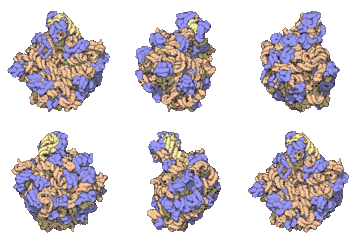
The prokaryotic large ribosomal subunit is a crucial component of the prokaryotic ribosome, which plays a fundamental role in the process of protein synthesis or translation in prokaryotes. This subunit, often referred to as the 50S subunit in prokaryotes, works in conjunction with the smaller 30S subunit to form the complete 70S ribosome. The designation of 50S and 30S is based on their sedimentation rates in a centrifugal field, denoted by the Svedberg (S) unit, which reflects their size and shape rather than their actual mass.
Structure and Function[edit]
The prokaryotic large ribosomal subunit is composed of ribosomal RNA (rRNA) and ribosomal proteins. Specifically, the 50S subunit of prokaryotes typically contains two rRNA molecules, the 23S rRNA and the 5S rRNA, along with approximately 34 different proteins. The 23S rRNA is instrumental in the catalytic peptidyl transferase activity, which forms peptide bonds between adjacent amino acids during protein synthesis. The 5S rRNA plays a role in maintaining the structural integrity of the ribosome and assists in the proper alignment of the rRNA and proteins.
The large subunit is primarily responsible for the formation of peptide bonds, a process known as peptidyl transferase activity. It also interacts with various transfer RNA (tRNA) molecules during translation, ensuring the correct assembly of amino acids into a polypeptide chain. The peptidyl transferase center, located within the 23S rRNA, is the enzymatic heart of the ribosome and is critical for protein synthesis.
Interaction with Antibiotics[edit]
The prokaryotic large ribosomal subunit is a target for several antibiotics that inhibit protein synthesis. Antibiotics such as chloramphenicol, erythromycin, and clindamycin bind to the 50S subunit, preventing peptide bond formation and thus inhibiting protein synthesis. This mechanism of action highlights the importance of the large ribosomal subunit in bacterial growth and reproduction, making it a critical target for antibacterial therapy.
Evolutionary Significance[edit]
The structure and function of the prokaryotic large ribosomal subunit have been conserved throughout evolution, indicating its essential role in cellular life. Comparative studies of the ribosomal RNA and proteins across different species have provided insights into the evolutionary history of the ribosome and the mechanisms of protein synthesis. The conservation of the peptidyl transferase center, in particular, underscores the universal nature of the protein synthesis machinery across all forms of life.
See Also[edit]

 | This medical article is a stub. You can help WikiMD by expanding the page. |
-
 Prokaryotic large ribosomal subunit
 -
 Prokaryotic large ribosomal subunit


Sponsored Health Resource

W8MD Weight Loss, Sleep & MedSpa
Looking for physician-supervised weight loss, semaglutide, tirzepatide, or GLP-1 receptor agonist options? W8MD helps eligible patients in New York City, Brooklyn, New Jersey, Connecticut, Pennsylvania, Delaware, and greater Philadelphia with medical weight loss, sleep medicine, and long-term maintenance support.
GLP-1 specials: Affordable GLP-1 injections NYC and Philadelphia starting from $29.99/week and up for semaglutide with insurance accepted for qualifying visits, and $45/week and up for tirzepatide with insurance accepted for qualifying visits. Self-pay options start from $59.99/week and up for semaglutide and $69.99/week and up for tirzepatide.
- Medical weight loss NYC
- Affordable GLP-1 injections NYC
- Budget GLP-1 weight loss shots Philadelphia
- New Jersey medical weight loss
- NYC medical weight loss blog
- Philadelphia weight loss blog
- Sleep medicine and sleep apnea services
- W8MD MedSpa and wellness
Book a W8MD appointment · View GLP-1 specials
Paid promotional message. Eligibility, pricing, insurance coverage, medication availability, and results vary. Medical evaluation required.

Medical Disclaimer: WikiMD is for informational purposes only and is not a substitute for professional medical advice. Content may be inaccurate or outdated and should not be used for diagnosis or treatment. Always consult your healthcare provider for medical decisions. Verify information with trusted sources such as CDC.gov and NIH.gov. By using this site, you agree that WikiMD is not liable for any outcomes related to its content. See full disclaimer.
Credits:Most images are courtesy of Wikimedia commons, and templates, categories Wikipedia, licensed under CC BY SA or similar.
Translate page: - East Asian
中文,
日本,
한국어,
South Asian
हिन्दी,
தமிழ்,
తెలుగు,
Urdu,
ಕನ್ನಡ,
Southeast Asian
Indonesian,
Vietnamese,
Thai,
မြန်မာဘာသာ,
বাংলা
European
español,
Deutsch,
français,
Greek,
português do Brasil,
polski,
română,
русский,
Nederlands,
norsk,
svenska,
suomi,
Italian
Middle Eastern & African
عربى,
Turkish,
Persian,
Hebrew,
Afrikaans,
isiZulu,
Kiswahili,
Other
Bulgarian,
Hungarian,
Czech,
Swedish,
മലയാളം,
मराठी,
ਪੰਜਾਬੀ,
ગુજરાતી,
Portuguese,
Ukrainian

