Critical mass
Critical mass is a term used in nuclear physics to describe the smallest amount of fissile material needed for a sustained nuclear chain reaction. The critical mass of a fissionable material depends upon its nuclear properties, its density, its shape, its enrichment, its purity, its temperature, and its surroundings.
Nuclear Physics[edit]
In nuclear physics, the critical mass is the minimum amount of nuclear material needed to make a nuclear bomb. It is the amount needed for a sustained nuclear chain reaction. The critical mass of a nuclear material depends on its nuclear properties (e.g., the nuclear fission cross-section), its density, its shape, its enrichment, its purity, its temperature, and its surroundings.
Fissile Material[edit]
Fissile material is material capable of sustaining a nuclear fission chain reaction. By definition, fissile material can sustain a chain reaction with neutrons of any energy. The predominant neutron energy may be typified by either slow neutrons (i.e., a thermal system) or fast neutrons.
Nuclear Chain Reaction[edit]
A nuclear chain reaction occurs when one single nuclear reaction causes an average of one or more subsequent nuclear reactions, thus leading to the possibility of a self-propagating series of these reactions. The specific nuclear reaction may be the fission of heavy isotopes (e.g., uranium-235, 235U).
See Also[edit]
References[edit]

This WikiMD article can only be edited by registered and verified editors. You can log in or register.
Critical_mass[edit]
-
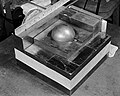 Partially reflected plutonium sphere
 -
 Critical mass
 -
 Nuclear predetonation


Medical Disclaimer: WikiMD is for informational purposes only and is not a substitute for professional medical advice. Content may be inaccurate or outdated and should not be used for diagnosis or treatment. Always consult your healthcare provider for medical decisions. Verify information with trusted sources such as CDC.gov and NIH.gov. By using this site, you agree that WikiMD is not liable for any outcomes related to its content. See full disclaimer.
Credits:Most images are courtesy of Wikimedia commons, and templates, categories Wikipedia, licensed under CC BY SA or similar.
Translate page: - East Asian
中文,
日本,
한국어,
South Asian
हिन्दी,
தமிழ்,
తెలుగు,
Urdu,
ಕನ್ನಡ,
Southeast Asian
Indonesian,
Vietnamese,
Thai,
မြန်မာဘာသာ,
বাংলা
European
español,
Deutsch,
français,
Greek,
português do Brasil,
polski,
română,
русский,
Nederlands,
norsk,
svenska,
suomi,
Italian
Middle Eastern & African
عربى,
Turkish,
Persian,
Hebrew,
Afrikaans,
isiZulu,
Kiswahili,
Other
Bulgarian,
Hungarian,
Czech,
Swedish,
മലയാളം,
मराठी,
ਪੰਜਾਬੀ,
ગુજરાતી,
Portuguese,
Ukrainian

