Gravitropism
Gravitropism is a directional growth movement which occurs in plants and fungi, allowing them to grow in response to gravity. This phenomenon is also known as geotropism. The primary role of gravitropism is to guide roots to grow downwards into the soil (positive gravitropism) and shoots to grow upwards, away from the earth (negative gravitropism), thus ensuring that the plant can both support itself and obtain water and nutrients from the soil.
Mechanism[edit]
The mechanism of gravitropism is complex and involves the perception of gravity by specialized cells, followed by a signal transduction pathway that leads to the differential growth of plant organs. In plants, Amyloplasts (starch-containing organelles) within the Statocytes in root cap and shoot tissues act as gravity sensors. These amyloplasts sediment in the direction of gravity, exerting pressure on the endoplasmic reticulum, which is thought to trigger a biochemical response leading to the growth modulation.
Auxin Distribution[edit]
The plant hormone Auxin plays a crucial role in gravitropism. Auxin distribution within the plant tissue changes in response to gravity, leading to differential growth. In roots, auxin accumulates on the lower side, inhibiting cell elongation and causing the root to bend downwards. Conversely, in shoots, auxin promotes cell elongation on the lower side, causing the shoot to bend upwards.
Types of Gravitropism[edit]
Gravitropism can be classified into two main types based on the direction of growth in relation to gravity:
- Positive Gravitropism: Growth towards the direction of gravity. This is observed in roots.
- Negative Gravitropism: Growth away from the direction of gravity. This is observed in shoots.
Function[edit]
Gravitropism allows plants to orient themselves correctly in their environment, ensuring that roots grow into the soil to absorb water and nutrients, while shoots grow upwards to access sunlight for photosynthesis. This directional growth is crucial for plant stability, nutrient uptake, and overall survival.
Research and Applications[edit]
Research into gravitropism has implications for agriculture, as understanding how plants sense and respond to gravity can help in developing crops that are more resilient to environmental stresses. Additionally, with the advent of space exploration, studying plant growth in microgravity environments has become important for developing life support systems in space habitats.
See Also[edit]

-
 Example of gravitropism found in a tree from Central Minnesota
 -
 Gravitropism tree
 -
 Gravitropism in Roots
 -
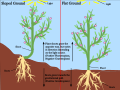 Gravitropism on flat and sloped ground
 -
 Gravitropism in Shoots
 -
 Gravitropism
 -
 Gravitropism


Sponsored Health Resource

W8MD Weight Loss, Sleep & MedSpa
Looking for physician-supervised weight loss, semaglutide, tirzepatide, or GLP-1 receptor agonist options? W8MD helps eligible patients in New York City, Brooklyn, New Jersey, Connecticut, Pennsylvania, Delaware, and greater Philadelphia with medical weight loss, sleep medicine, and long-term maintenance support.
GLP-1 specials: Affordable GLP-1 injections NYC and Philadelphia starting from $29.99/week and up for semaglutide with insurance accepted for qualifying visits, and $45/week and up for tirzepatide with insurance accepted for qualifying visits. Self-pay options start from $59.99/week and up for semaglutide and $69.99/week and up for tirzepatide.
- Medical weight loss NYC
- Affordable GLP-1 injections NYC
- Budget GLP-1 weight loss shots Philadelphia
- New Jersey medical weight loss
- NYC medical weight loss blog
- Philadelphia weight loss blog
- Sleep medicine and sleep apnea services
- W8MD MedSpa and wellness
Book a W8MD appointment · View GLP-1 specials
Paid promotional message. Eligibility, pricing, insurance coverage, medication availability, and results vary. Medical evaluation required.

Medical Disclaimer: WikiMD is for informational purposes only and is not a substitute for professional medical advice. Content may be inaccurate or outdated and should not be used for diagnosis or treatment. Always consult your healthcare provider for medical decisions. Verify information with trusted sources such as CDC.gov and NIH.gov. By using this site, you agree that WikiMD is not liable for any outcomes related to its content. See full disclaimer.
Credits:Most images are courtesy of Wikimedia commons, and templates, categories Wikipedia, licensed under CC BY SA or similar.
Translate page: - East Asian
中文,
日本,
한국어,
South Asian
हिन्दी,
தமிழ்,
తెలుగు,
Urdu,
ಕನ್ನಡ,
Southeast Asian
Indonesian,
Vietnamese,
Thai,
မြန်မာဘာသာ,
বাংলা
European
español,
Deutsch,
français,
Greek,
português do Brasil,
polski,
română,
русский,
Nederlands,
norsk,
svenska,
suomi,
Italian
Middle Eastern & African
عربى,
Turkish,
Persian,
Hebrew,
Afrikaans,
isiZulu,
Kiswahili,
Other
Bulgarian,
Hungarian,
Czech,
Swedish,
മലയാളം,
मराठी,
ਪੰਜਾਬੀ,
ગુજરાતી,
Portuguese,
Ukrainian

