Amrinone
Amrinone or Inamrinone is a type of phosphodiesterase inhibitor used primarily in the treatment of congestive heart failure (CHF). It works by inhibiting the enzyme phosphodiesterase 3 (PDE3), which leads to an increase in intracellular cAMP and improved cardiac output without a significant increase in heart rate. Amrinone is classified as a positive inotrope, meaning it increases the strength of the heart's contractions, and a vasodilator, as it widens blood vessels, reducing the workload on the heart.
Mechanism of Action[edit]
Amrinone acts by inhibiting PDE3, an enzyme that breaks down cAMP. The accumulation of cAMP leads to an increase in calcium ions within cardiac muscle cells, enhancing myocardial contractility (the ability of the heart muscle to contract) and leading to a positive inotropic effect. Additionally, the vasodilatory effect is achieved through the relaxation of vascular smooth muscle, which results in decreased peripheral vascular resistance and reduced afterload on the heart.
Clinical Use[edit]
Amrinone is used in the management of acute exacerbations of CHF, where it can improve symptoms and increase cardiac output. It is often administered intravenously in a hospital setting due to its potent effects and the need for close monitoring of the patient.
Side Effects[edit]
The use of Amrinone can be associated with several side effects, including thrombocytopenia (a decrease in the number of platelets in the blood, which can lead to increased bleeding), arrhythmias (irregular heartbeats), and hypotension (low blood pressure). Due to these potential side effects, careful monitoring of the patient is required during treatment.
Comparison with Other Therapies[edit]
Amrinone is one of several drugs available for the treatment of CHF. It is often compared to digoxin, another positive inotrope, and beta blockers, which have a different mechanism of action but are also used in the management of CHF. Unlike digoxin, Amrinone does not have a direct effect on the autonomic nervous system, and its use is typically reserved for acute settings rather than long-term management.
Limitations and Considerations[edit]
The use of Amrinone is limited by its side effects, particularly the risk of thrombocytopenia and the potential for arrhythmias. It is also contraindicated in patients with severe aortic stenosis due to the risk of exacerbating outflow obstruction. Furthermore, the benefits of Amrinone in long-term management of CHF are less clear, and it is generally not used as a first-line treatment for chronic CHF.
Conclusion[edit]
Amrinone serves as an important option in the acute management of CHF, particularly in cases where rapid improvement in cardiac output is needed. However, its use must be carefully balanced against the potential for significant side effects, and it is typically employed as part of a broader treatment strategy that may include other medications and interventions aimed at managing CHF.
 | This medical article is a stub. You can help WikiMD by expanding the page. |
-
 Amrinone chemical structure
 -
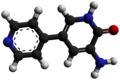 3D molecular model of Amrinone
 -
 Synthesis pathway of Amrinone


Sponsored Health Resource

W8MD Weight Loss, Sleep & MedSpa
Looking for physician-supervised weight loss, semaglutide, tirzepatide, or GLP-1 receptor agonist options? W8MD helps eligible patients in New York City, Brooklyn, New Jersey, Connecticut, Pennsylvania, Delaware, and greater Philadelphia with medical weight loss, sleep medicine, and long-term maintenance support.
GLP-1 specials: Affordable GLP-1 injections NYC and Philadelphia starting from $29.99/week and up for semaglutide with insurance accepted for qualifying visits, and $45/week and up for tirzepatide with insurance accepted for qualifying visits. Self-pay options start from $59.99/week and up for semaglutide and $69.99/week and up for tirzepatide.
- Medical weight loss NYC
- Affordable GLP-1 injections NYC
- Budget GLP-1 weight loss shots Philadelphia
- New Jersey medical weight loss
- NYC medical weight loss blog
- Philadelphia weight loss blog
- Sleep medicine and sleep apnea services
- W8MD MedSpa and wellness
Book a W8MD appointment · View GLP-1 specials
Paid promotional message. Eligibility, pricing, insurance coverage, medication availability, and results vary. Medical evaluation required.

Medical Disclaimer: WikiMD is for informational purposes only and is not a substitute for professional medical advice. Content may be inaccurate or outdated and should not be used for diagnosis or treatment. Always consult your healthcare provider for medical decisions. Verify information with trusted sources such as CDC.gov and NIH.gov. By using this site, you agree that WikiMD is not liable for any outcomes related to its content. See full disclaimer.
Credits:Most images are courtesy of Wikimedia commons, and templates, categories Wikipedia, licensed under CC BY SA or similar.
Translate page: - East Asian
中文,
日本,
한국어,
South Asian
हिन्दी,
தமிழ்,
తెలుగు,
Urdu,
ಕನ್ನಡ,
Southeast Asian
Indonesian,
Vietnamese,
Thai,
မြန်မာဘာသာ,
বাংলা
European
español,
Deutsch,
français,
Greek,
português do Brasil,
polski,
română,
русский,
Nederlands,
norsk,
svenska,
suomi,
Italian
Middle Eastern & African
عربى,
Turkish,
Persian,
Hebrew,
Afrikaans,
isiZulu,
Kiswahili,
Other
Bulgarian,
Hungarian,
Czech,
Swedish,
മലയാളം,
मराठी,
ਪੰਜਾਬੀ,
ગુજરાતી,
Portuguese,
Ukrainian

