Cutaneous innervation of the upper limbs
Overview of the nerve supply to the skin of the upper limbs
The cutaneous innervation of the upper limbs refers to the distribution of sensory nerves that supply the skin of the upper limbs, including the shoulder, arm, forearm, and hand. These nerves are responsible for transmitting sensory information such as touch, pain, temperature, and proprioception from the skin to the central nervous system.
Overview[edit]
The cutaneous innervation of the upper limbs is primarily provided by the brachial plexus, a network of nerves that originates from the spinal cord in the neck region. The brachial plexus gives rise to several major nerves that supply both motor and sensory innervation to the upper limbs. The sensory branches of these nerves are responsible for the cutaneous innervation.
Major Nerves and Their Cutaneous Branches[edit]
Axillary Nerve[edit]
The axillary nerve arises from the posterior cord of the brachial plexus and provides cutaneous innervation to the skin over the deltoid muscle and the lateral aspect of the shoulder. The sensory branch responsible for this is the superior lateral cutaneous nerve of the arm.
Radial Nerve[edit]
The radial nerve is a major nerve of the upper limb that supplies the posterior aspect of the arm and forearm. Its cutaneous branches include:
- The posterior cutaneous nerve of the arm, which supplies the skin on the posterior surface of the arm.
- The posterior cutaneous nerve of the forearm, which supplies the skin on the posterior surface of the forearm.
- The superficial branch of the radial nerve, which supplies the skin on the dorsal aspect of the hand and the dorsal surfaces of the lateral three and a half fingers, excluding the fingertips.
Musculocutaneous Nerve[edit]
The musculocutaneous nerve provides motor innervation to the anterior compartment of the arm and gives rise to the lateral cutaneous nerve of the forearm, which supplies the skin on the lateral aspect of the forearm.
Median Nerve[edit]
The median nerve is responsible for the cutaneous innervation of the palmar aspect of the lateral three and a half fingers and the corresponding area of the palm. It also supplies the fingertips of these fingers on the dorsal side.
Ulnar Nerve[edit]
The ulnar nerve supplies the skin on the palmar and dorsal aspects of the medial one and a half fingers and the corresponding area of the palm and dorsum of the hand.
Dermatomes[edit]
The skin of the upper limbs is divided into specific areas known as dermatomes, each of which is innervated by a single spinal nerve root. The dermatomes of the upper limb are organized in a pattern that reflects the embryological development of the limb. Key dermatomes include:
- C5: Lateral aspect of the arm
- C6: Lateral aspect of the forearm and thumb
- C7: Middle finger
- C8: Little finger and medial aspect of the hand
- T1: Medial aspect of the forearm
Clinical Significance[edit]
Understanding the cutaneous innervation of the upper limbs is crucial for diagnosing and managing conditions that affect sensory perception, such as nerve injuries, neuropathies, and dermatological conditions. It is also important in surgical planning and in the administration of regional anesthesia.
Related Pages[edit]

-
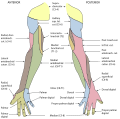 Gray's Anatomy illustration of cutaneous innervation of the upper limbs

Sponsored Health Resource

W8MD Weight Loss, Sleep & MedSpa
Looking for physician-supervised weight loss, semaglutide, tirzepatide, or GLP-1 receptor agonist options? W8MD helps eligible patients in New York City, Brooklyn, New Jersey, Connecticut, Pennsylvania, Delaware, and greater Philadelphia with medical weight loss, sleep medicine, and long-term maintenance support.
GLP-1 specials: Affordable GLP-1 injections NYC and Philadelphia starting from $29.99/week and up for semaglutide with insurance accepted for qualifying visits, and $45/week and up for tirzepatide with insurance accepted for qualifying visits. Self-pay options start from $59.99/week and up for semaglutide and $69.99/week and up for tirzepatide.
- Medical weight loss NYC
- Affordable GLP-1 injections NYC
- Budget GLP-1 weight loss shots Philadelphia
- New Jersey medical weight loss
- NYC medical weight loss blog
- Philadelphia weight loss blog
- Sleep medicine and sleep apnea services
- W8MD MedSpa and wellness
Book a W8MD appointment · View GLP-1 specials
Paid promotional message. Eligibility, pricing, insurance coverage, medication availability, and results vary. Medical evaluation required.

Medical Disclaimer: WikiMD is for informational purposes only and is not a substitute for professional medical advice. Content may be inaccurate or outdated and should not be used for diagnosis or treatment. Always consult your healthcare provider for medical decisions. Verify information with trusted sources such as CDC.gov and NIH.gov. By using this site, you agree that WikiMD is not liable for any outcomes related to its content. See full disclaimer.
Credits:Most images are courtesy of Wikimedia commons, and templates, categories Wikipedia, licensed under CC BY SA or similar.
Translate page: - East Asian
中文,
日本,
한국어,
South Asian
हिन्दी,
தமிழ்,
తెలుగు,
Urdu,
ಕನ್ನಡ,
Southeast Asian
Indonesian,
Vietnamese,
Thai,
မြန်မာဘာသာ,
বাংলা
European
español,
Deutsch,
français,
Greek,
português do Brasil,
polski,
română,
русский,
Nederlands,
norsk,
svenska,
suomi,
Italian
Middle Eastern & African
عربى,
Turkish,
Persian,
Hebrew,
Afrikaans,
isiZulu,
Kiswahili,
Other
Bulgarian,
Hungarian,
Czech,
Swedish,
മലയാളം,
मराठी,
ਪੰਜਾਬੀ,
ગુજરાતી,
Portuguese,
Ukrainian

