Potato starch
Potato Starch is a type of starch extracted from potatoes. The cells of the root tubers of the potato plant contain starch granules (leucoplasts). To extract the starch, the potatoes are crushed, and the starch grains are released from the destroyed cells. The starch is then washed out and dried to powder.
Production[edit]
Potato starch production is a well-defined process that involves several stages. The potatoes are first cleaned and sorted to remove any impurities. They are then crushed to release the starch granules from the cells. The resulting mixture is then sieved to remove the fibrous material, leaving behind a liquid that contains the starch. This liquid is then allowed to settle, after which the water is drained off, leaving behind the starch. The starch is then dried to produce a fine powder.
Uses[edit]
Potato starch is used in a variety of ways in cooking and baking. It is often used as a thickener for sauces, soups, and stews. It is also used in baking, particularly in gluten-free recipes. In addition to its culinary uses, potato starch is also used in the textile industry, in the production of adhesives and glues, and in the pharmaceutical industry.
Nutritional Value[edit]
Potato starch is high in carbohydrates, but it is also a good source of energy. It is low in protein and fat, and it is gluten-free, making it a good option for those with Celiac disease or a sensitivity to gluten.
See Also[edit]
References[edit]

-
Potato starch
-
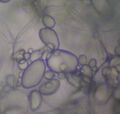 Amyloplasts in potato cells
 -
Potato starch under polarized light

Sponsored Health Resource

W8MD Weight Loss, Sleep & MedSpa
Looking for physician-supervised weight loss, semaglutide, tirzepatide, or GLP-1 receptor agonist options? W8MD helps eligible patients in New York City, Brooklyn, New Jersey, Connecticut, Pennsylvania, Delaware, and greater Philadelphia with medical weight loss, sleep medicine, and long-term maintenance support.
GLP-1 specials: Affordable GLP-1 injections NYC and Philadelphia starting from $29.99/week and up for semaglutide with insurance accepted for qualifying visits, and $45/week and up for tirzepatide with insurance accepted for qualifying visits. Self-pay options start from $59.99/week and up for semaglutide and $69.99/week and up for tirzepatide.
- Medical weight loss NYC
- Affordable GLP-1 injections NYC
- Budget GLP-1 weight loss shots Philadelphia
- New Jersey medical weight loss
- NYC medical weight loss blog
- Philadelphia weight loss blog
- Sleep medicine and sleep apnea services
- W8MD MedSpa and wellness
Book a W8MD appointment · View GLP-1 specials
Paid promotional message. Eligibility, pricing, insurance coverage, medication availability, and results vary. Medical evaluation required.

Medical Disclaimer: WikiMD is for informational purposes only and is not a substitute for professional medical advice. Content may be inaccurate or outdated and should not be used for diagnosis or treatment. Always consult your healthcare provider for medical decisions. Verify information with trusted sources such as CDC.gov and NIH.gov. By using this site, you agree that WikiMD is not liable for any outcomes related to its content. See full disclaimer.
Credits:Most images are courtesy of Wikimedia commons, and templates, categories Wikipedia, licensed under CC BY SA or similar.
Translate page: - East Asian
中文,
日本,
한국어,
South Asian
हिन्दी,
தமிழ்,
తెలుగు,
Urdu,
ಕನ್ನಡ,
Southeast Asian
Indonesian,
Vietnamese,
Thai,
မြန်မာဘာသာ,
বাংলা
European
español,
Deutsch,
français,
Greek,
português do Brasil,
polski,
română,
русский,
Nederlands,
norsk,
svenska,
suomi,
Italian
Middle Eastern & African
عربى,
Turkish,
Persian,
Hebrew,
Afrikaans,
isiZulu,
Kiswahili,
Other
Bulgarian,
Hungarian,
Czech,
Swedish,
മലയാളം,
मराठी,
ਪੰਜਾਬੀ,
ગુજરાતી,
Portuguese,
Ukrainian


