Natural rubber
Natural rubber, also known as India rubber, latex, Amazonian rubber, caucho or caoutchouc, is a type of polymer that is derived from the sap of the rubber tree (Hevea brasiliensis). It is a natural biopolymer that has been used for thousands of years in various cultures around the world.
History[edit]
The use of natural rubber dates back to prehistoric times, with evidence of its use found in ancient Mesoamerica. The Olmec civilization, one of the earliest in the Americas, used rubber to make balls for a game that was a precursor to modern soccer.
In the 19th century, the demand for rubber grew rapidly with the industrial revolution. The British explorer Henry Wickham smuggled rubber tree seeds from Brazil to England, leading to the establishment of rubber plantations in British colonies such as Malaysia and Sri Lanka.
Production[edit]
Natural rubber is produced from the latex sap of the rubber tree. The sap is collected by making a cut in the tree's bark and allowing the sap to drip into a container. This process is known as "tapping". The collected latex is then coagulated using acid, and the resulting rubber is dried and pressed into sheets or blocks.
Properties and uses[edit]
Natural rubber is highly elastic, waterproof, and resistant to abrasion and impact. These properties make it ideal for a wide range of applications, including tires, gloves, balloons, and medical devices such as catheters and surgical gloves.
Despite its many uses, natural rubber has some limitations. It is not resistant to oil, grease, and certain types of chemicals. It also degrades over time when exposed to heat and sunlight.
Environmental impact[edit]
The production of natural rubber has significant environmental impacts. Rubber plantations often replace natural forests, leading to loss of biodiversity. The use of pesticides and fertilizers in rubber plantations can also pollute water sources.
However, natural rubber is biodegradable and can be recycled, making it a more sustainable option than synthetic rubbers in some applications.
See also[edit]

This WikiMD article can only be edited by registered and verified editors. You can log in or register.
-
 Natural rubber
 -
 Natural rubber
 -
 Natural rubber
 -
 Natural rubber
 -
 Natural rubber
 -
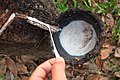 Natural rubber
 -
 Natural rubber
 -
 Natural rubber
 -
 Natural rubber
 -
 Natural rubber
 -
 Natural rubber
 -
 Natural rubber


Sponsored Health Resource

W8MD Weight Loss, Sleep & MedSpa
Looking for physician-supervised weight loss, semaglutide, tirzepatide, or GLP-1 receptor agonist options? W8MD helps eligible patients in New York City, Brooklyn, New Jersey, Connecticut, Pennsylvania, Delaware, and greater Philadelphia with medical weight loss, sleep medicine, and long-term maintenance support.
GLP-1 specials: Affordable GLP-1 injections NYC and Philadelphia starting from $29.99/week and up for semaglutide with insurance accepted for qualifying visits, and $45/week and up for tirzepatide with insurance accepted for qualifying visits. Self-pay options start from $59.99/week and up for semaglutide and $69.99/week and up for tirzepatide.
- Medical weight loss NYC
- Affordable GLP-1 injections NYC
- Budget GLP-1 weight loss shots Philadelphia
- New Jersey medical weight loss
- NYC medical weight loss blog
- Philadelphia weight loss blog
- Sleep medicine and sleep apnea services
- W8MD MedSpa and wellness
Book a W8MD appointment · View GLP-1 specials
Paid promotional message. Eligibility, pricing, insurance coverage, medication availability, and results vary. Medical evaluation required.

Medical Disclaimer: WikiMD is for informational purposes only and is not a substitute for professional medical advice. Content may be inaccurate or outdated and should not be used for diagnosis or treatment. Always consult your healthcare provider for medical decisions. Verify information with trusted sources such as CDC.gov and NIH.gov. By using this site, you agree that WikiMD is not liable for any outcomes related to its content. See full disclaimer.
Credits:Most images are courtesy of Wikimedia commons, and templates, categories Wikipedia, licensed under CC BY SA or similar.
Translate page: - East Asian
中文,
日本,
한국어,
South Asian
हिन्दी,
தமிழ்,
తెలుగు,
Urdu,
ಕನ್ನಡ,
Southeast Asian
Indonesian,
Vietnamese,
Thai,
မြန်မာဘာသာ,
বাংলা
European
español,
Deutsch,
français,
Greek,
português do Brasil,
polski,
română,
русский,
Nederlands,
norsk,
svenska,
suomi,
Italian
Middle Eastern & African
عربى,
Turkish,
Persian,
Hebrew,
Afrikaans,
isiZulu,
Kiswahili,
Other
Bulgarian,
Hungarian,
Czech,
Swedish,
മലയാളം,
मराठी,
ਪੰਜਾਬੀ,
ગુજરાતી,
Portuguese,
Ukrainian

