Descending genicular artery
The descending genicular artery emerges as a crucial branch of the femoral artery shortly before it passes through the adductor hiatus to become the popliteal artery. This artery plays a significant role in supplying blood to the knee joint, the sartorius muscle, and the adjacent regions of the thigh and calf. Its importance is underscored in surgical procedures and in understanding the vascular anatomy of the knee area.
Anatomy[edit]
The descending genicular artery originates from the femoral artery, typically in the thigh's distal third. It descends towards the knee, giving off a saphenous branch that accompanies the saphenous nerve and a muscular branch. As it approaches the knee, it divides into articular and saphenous branches. The articular branch further subdivides into the medial and lateral superior genicular arteries, contributing to the vascular network around the knee joint. The saphenous branch, on the other hand, runs along with the saphenous nerve and participates in the vascular supply of the skin overlying the medial side of the knee.
Function[edit]
The primary function of the descending genicular artery is to supply blood to the knee joint and the surrounding musculature. It plays a vital role in maintaining the health and functionality of the knee, especially in scenarios of trauma or surgical intervention where the main arterial supply might be compromised. Its branches, particularly the saphenous and articular branches, ensure a collateral circulation that can be crucial in cases of arterial occlusion.
Clinical Significance[edit]
- Arterial Occlusion
In the event of femoral artery occlusion, the descending genicular artery's role in providing collateral circulation becomes paramount. It can help maintain blood flow to the lower leg and foot, potentially preventing ischemic complications.
- Surgical Procedures
During knee surgeries, such as total knee arthroplasty, the descending genicular artery may be at risk of injury. Knowledge of its anatomy is crucial to avoid inadvertent damage and subsequent complications, such as hematoma formation or compromised blood supply to the knee.
- Diagnostic Imaging
In diagnostic imaging, particularly angiography, the descending genicular artery can serve as a landmark for identifying the level of femoral artery bifurcation. It also aids in the assessment of vascular diseases affecting the lower extremities.
See Also[edit]
References[edit]

```
Descending genicular artery[edit]
-
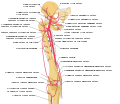 Diagram of the thigh arteries, including the descending genicular artery.

Sponsored Health Resource

W8MD Weight Loss, Sleep & MedSpa
Looking for physician-supervised weight loss, semaglutide, tirzepatide, or GLP-1 receptor agonist options? W8MD helps eligible patients in New York City, Brooklyn, New Jersey, Connecticut, Pennsylvania, Delaware, and greater Philadelphia with medical weight loss, sleep medicine, and long-term maintenance support.
GLP-1 specials: Affordable GLP-1 injections NYC and Philadelphia starting from $29.99/week and up for semaglutide with insurance accepted for qualifying visits, and $45/week and up for tirzepatide with insurance accepted for qualifying visits. Self-pay options start from $59.99/week and up for semaglutide and $69.99/week and up for tirzepatide.
- Medical weight loss NYC
- Affordable GLP-1 injections NYC
- Budget GLP-1 weight loss shots Philadelphia
- New Jersey medical weight loss
- NYC medical weight loss blog
- Philadelphia weight loss blog
- Sleep medicine and sleep apnea services
- W8MD MedSpa and wellness
Book a W8MD appointment · View GLP-1 specials
Paid promotional message. Eligibility, pricing, insurance coverage, medication availability, and results vary. Medical evaluation required.

Medical Disclaimer: WikiMD is for informational purposes only and is not a substitute for professional medical advice. Content may be inaccurate or outdated and should not be used for diagnosis or treatment. Always consult your healthcare provider for medical decisions. Verify information with trusted sources such as CDC.gov and NIH.gov. By using this site, you agree that WikiMD is not liable for any outcomes related to its content. See full disclaimer.
Credits:Most images are courtesy of Wikimedia commons, and templates, categories Wikipedia, licensed under CC BY SA or similar.
Translate page: - East Asian
中文,
日本,
한국어,
South Asian
हिन्दी,
தமிழ்,
తెలుగు,
Urdu,
ಕನ್ನಡ,
Southeast Asian
Indonesian,
Vietnamese,
Thai,
မြန်မာဘာသာ,
বাংলা
European
español,
Deutsch,
français,
Greek,
português do Brasil,
polski,
română,
русский,
Nederlands,
norsk,
svenska,
suomi,
Italian
Middle Eastern & African
عربى,
Turkish,
Persian,
Hebrew,
Afrikaans,
isiZulu,
Kiswahili,
Other
Bulgarian,
Hungarian,
Czech,
Swedish,
മലയാളം,
मराठी,
ਪੰਜਾਬੀ,
ગુજરાતી,
Portuguese,
Ukrainian

