Blåbärssoppa
Blåbärssoppa is a traditional Swedish dish, typically served as a dessert or a snack. It is a soup made from bilberries, which are a type of wild blueberry native to Europe. The soup is often sweetened with sugar and thickened with starch or flour. It can be served either hot or cold, and is sometimes accompanied by a dollop of whipped cream or a scoop of vanilla ice cream.
History[edit]
The tradition of making blåbärssoppa dates back to at least the 18th century in Sweden. Bilberries were abundant in the Swedish countryside, and the soup was a way to make use of this plentiful resource. The soup was traditionally made in the summer, when the berries were in season, and then preserved for use throughout the winter.
Preparation[edit]
To prepare blåbärssoppa, the bilberries are first washed and then boiled in water. Once the berries have softened, they are pureed and strained to remove the skins and seeds. The resulting liquid is then returned to the heat and sweetened with sugar. Some recipes also call for the addition of lemon juice or cinnamon for added flavor. The soup is then thickened with a starch, such as potato starch or cornstarch, or a flour, such as wheat flour or rice flour.
Serving[edit]
Blåbärssoppa can be served either hot or cold, depending on personal preference. It is often served as a dessert, but can also be served as a snack or a light meal. Some people enjoy it with a dollop of whipped cream or a scoop of vanilla ice cream. It is also commonly served at Swedish breakfast buffets.
Cultural Significance[edit]
In Sweden, blåbärssoppa is often associated with outdoor activities, such as hiking and skiing. It is a common item in the food packs of the Swedish military, and is also served to participants in the Vasaloppet, a long-distance cross-country ski race held annually in Sweden.
| Swedish cuisine | ||||||||||
|---|---|---|---|---|---|---|---|---|---|---|
This Swedish cuisine related article is a stub.
|

-
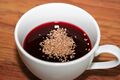 Blåbärssoppa

Sponsored Health Resource

W8MD Weight Loss, Sleep & MedSpa
Looking for physician-supervised weight loss, semaglutide, tirzepatide, or GLP-1 receptor agonist options? W8MD helps eligible patients in New York City, Brooklyn, New Jersey, Connecticut, Pennsylvania, Delaware, and greater Philadelphia with medical weight loss, sleep medicine, and long-term maintenance support.
GLP-1 specials: Affordable GLP-1 injections NYC and Philadelphia starting from $29.99/week and up for semaglutide with insurance accepted for qualifying visits, and $45/week and up for tirzepatide with insurance accepted for qualifying visits. Self-pay options start from $59.99/week and up for semaglutide and $69.99/week and up for tirzepatide.
Medical weight loss NYC | Affordable GLP-1 injections NYC | Budget GLP-1 weight loss shots Philadelphia | New Jersey medical weight loss | NYC medical weight loss | Philadelphia medical weight loss | Sleep clinic NYC | W8MD's Philadelphia GLP-1 doctor | Weight loss prescriptions NYC
Book a W8MD appointment · View GLP-1 specials
Paid promotional message. Eligibility, pricing, insurance coverage, medication availability, and results vary. Medical evaluation required.

Medical Disclaimer: WikiMD is for informational purposes only and is not a substitute for professional medical advice. Content may be inaccurate or outdated and should not be used for diagnosis or treatment. Always consult your healthcare provider for medical decisions. Verify information with trusted sources such as CDC.gov and NIH.gov. By using this site, you agree that WikiMD is not liable for any outcomes related to its content. See full disclaimer.
Credits:Most images are courtesy of Wikimedia commons, and templates, categories Wikipedia, licensed under CC BY SA or similar.
Translate page: - East Asian
中文,
日本,
한국어,
South Asian
हिन्दी,
தமிழ்,
తెలుగు,
Urdu,
ಕನ್ನಡ,
Southeast Asian
Indonesian,
Vietnamese,
Thai,
မြန်မာဘာသာ,
বাংলা
European
español,
Deutsch,
français,
Greek,
português do Brasil,
polski,
română,
русский,
Nederlands,
norsk,
svenska,
suomi,
Italian
Middle Eastern & African
عربى,
Turkish,
Persian,
Hebrew,
Afrikaans,
isiZulu,
Kiswahili,
Other
Bulgarian,
Hungarian,
Czech,
Swedish,
മലയാളം,
मराठी,
ਪੰਜਾਬੀ,
ગુજરાતી,
Portuguese,
Ukrainian

