Fourth ventricle
The Fourth ventricle is one of the four connected fluid-filled cavities within the human brain. These cavities, known as ventricles, are responsible for the production, transport and removal of cerebrospinal fluid, which bathes the central nervous system.
Anatomy[edit]
The fourth ventricle extends from the obex to a region in the brain called the cerebral aqueduct. It is located within the pons and the medulla oblongata, two important structures in the brainstem. The fourth ventricle has a characteristic diamond shape in cross-sections of the human brain. It is continuous with the central canal of the spinal cord and connects to the subarachnoid space through three openings - the median aperture and the two lateral apertures.
Function[edit]
The primary function of the fourth ventricle, like other brain ventricles, is to produce and transport cerebrospinal fluid. This fluid serves several important functions in the central nervous system, including the provision of buoyancy and protection for the brain, transportation of nutrients, and removal of waste products.
Clinical significance[edit]
Abnormalities or blockages of the fourth ventricle can lead to conditions such as hydrocephalus, a condition characterized by an excessive accumulation of cerebrospinal fluid in the brain. This can cause increased intracranial pressure and can lead to symptoms such as headache, nausea, vomiting, and in severe cases, can be life-threatening.
See also[edit]
References[edit]

This WikiMD article can only be edited by registered and verified editors. You can log in or register.
-
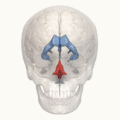 Fourth ventricle animation
 -
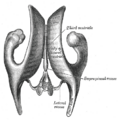 Fourth ventricle in the brain
 -
 Fourth ventricle in the human cerebellum
 -
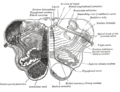 Fourth ventricle and surrounding structures
 -
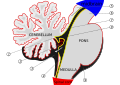 Fourth ventricle anatomy
 -
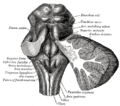 Fourth ventricle and brainstem
 -
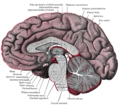 Fourth ventricle and cranial nerves
 -
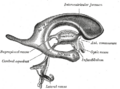 Fourth ventricle and cerebellum
 -
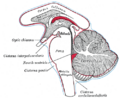 Fourth ventricle and ventricular system
 -
 Fourth ventricle


Medical Disclaimer: WikiMD is for informational purposes only and is not a substitute for professional medical advice. Content may be inaccurate or outdated and should not be used for diagnosis or treatment. Always consult your healthcare provider for medical decisions. Verify information with trusted sources such as CDC.gov and NIH.gov. By using this site, you agree that WikiMD is not liable for any outcomes related to its content. See full disclaimer.
Credits:Most images are courtesy of Wikimedia commons, and templates, categories Wikipedia, licensed under CC BY SA or similar.
Translate page: - East Asian
中文,
日本,
한국어,
South Asian
हिन्दी,
தமிழ்,
తెలుగు,
Urdu,
ಕನ್ನಡ,
Southeast Asian
Indonesian,
Vietnamese,
Thai,
မြန်မာဘာသာ,
বাংলা
European
español,
Deutsch,
français,
Greek,
português do Brasil,
polski,
română,
русский,
Nederlands,
norsk,
svenska,
suomi,
Italian
Middle Eastern & African
عربى,
Turkish,
Persian,
Hebrew,
Afrikaans,
isiZulu,
Kiswahili,
Other
Bulgarian,
Hungarian,
Czech,
Swedish,
മലയാളം,
मराठी,
ਪੰਜਾਬੀ,
ગુજરાતી,
Portuguese,
Ukrainian

