Kallikrein
Kallikrein is a subgroup of serine proteases that are involved in various physiological processes, including blood coagulation, inflammation, and fibrinolysis. These enzymes are known for their ability to cleave peptide bonds in proteins, thereby activating or inactivating them.
Structure and Function[edit]
Kallikreins are characterized by their serine protease activity, which means they have a serine residue at their active site that plays a crucial role in their enzymatic function. They are synthesized as inactive precursors called zymogens and are activated by proteolytic cleavage.
Kallikreins are involved in the kinin-kallikrein system, where they cleave kininogen to release bradykinin, a peptide that causes blood vessels to dilate and lowers blood pressure. This system plays a significant role in the regulation of blood pressure, inflammation, and pain.
Types of Kallikreins[edit]
There are two main types of kallikreins:
- Plasma kallikrein: This type circulates in the blood and is involved in the intrinsic pathway of the coagulation cascade. It also plays a role in the activation of the complement system.
- Tissue kallikrein: Found in various tissues, this type is involved in the local generation of kinins and other biologically active peptides.
Role in Fibrinolysis[edit]
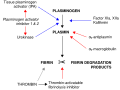
Kallikrein plays a crucial role in the process of fibrinolysis, which is the breakdown of fibrin in blood clots. It activates plasminogen to plasmin, the enzyme responsible for degrading fibrin. This process is essential for maintaining blood flow and preventing thrombosis.
Clinical Significance[edit]
Dysregulation of kallikrein activity can lead to various medical conditions. For example, excessive kallikrein activity can result in hereditary angioedema, a condition characterized by episodes of severe swelling. Conversely, insufficient kallikrein activity can contribute to hypertension and thrombosis.
Kallikreins are also being studied as potential biomarkers for certain cancers, such as prostate cancer, where kallikrein-related peptidase 3 (KLK3), also known as prostate-specific antigen (PSA), is used in screening and monitoring.
Related Pages[edit]
-
 Kallikrein

Sponsored Health Resource

W8MD Weight Loss, Sleep & MedSpa
Looking for physician-supervised weight loss, semaglutide, tirzepatide, or GLP-1 receptor agonist options? W8MD helps eligible patients in New York City, Brooklyn, New Jersey, Connecticut, Pennsylvania, Delaware, and greater Philadelphia with medical weight loss, sleep medicine, and long-term maintenance support.
GLP-1 specials: Affordable GLP-1 injections NYC and Philadelphia starting from $29.99/week and up for semaglutide with insurance accepted for qualifying visits, and $45/week and up for tirzepatide with insurance accepted for qualifying visits. Self-pay options start from $59.99/week and up for semaglutide and $69.99/week and up for tirzepatide.
Medical weight loss NYC | Affordable GLP-1 injections NYC | Budget GLP-1 weight loss shots Philadelphia | New Jersey medical weight loss | NYC medical weight loss | Philadelphia medical weight loss | Sleep clinic NYC | W8MD's Philadelphia GLP-1 doctor | Weight loss prescriptions NYC
Book a W8MD appointment · View GLP-1 specials
Paid promotional message. Eligibility, pricing, insurance coverage, medication availability, and results vary. Medical evaluation required.

Medical Disclaimer: WikiMD is for informational purposes only and is not a substitute for professional medical advice. Content may be inaccurate or outdated and should not be used for diagnosis or treatment. Always consult your healthcare provider for medical decisions. Verify information with trusted sources such as CDC.gov and NIH.gov. By using this site, you agree that WikiMD is not liable for any outcomes related to its content. See full disclaimer.
Credits:Most images are courtesy of Wikimedia commons, and templates, categories Wikipedia, licensed under CC BY SA or similar.
Translate page: - East Asian
中文,
日本,
한국어,
South Asian
हिन्दी,
தமிழ்,
తెలుగు,
Urdu,
ಕನ್ನಡ,
Southeast Asian
Indonesian,
Vietnamese,
Thai,
မြန်မာဘာသာ,
বাংলা
European
español,
Deutsch,
français,
Greek,
português do Brasil,
polski,
română,
русский,
Nederlands,
norsk,
svenska,
suomi,
Italian
Middle Eastern & African
عربى,
Turkish,
Persian,
Hebrew,
Afrikaans,
isiZulu,
Kiswahili,
Other
Bulgarian,
Hungarian,
Czech,
Swedish,
മലയാളം,
मराठी,
ਪੰਜਾਬੀ,
ગુજરાતી,
Portuguese,
Ukrainian

