Phenprocoumon
Phenprocoumon is an anticoagulant of the coumarin class, used to prevent and treat thrombosis and embolism. It is a vitamin K antagonist (VKA) similar to warfarin and is used particularly in some European countries. Phenprocoumon's anticoagulant effects are achieved by inhibiting the synthesis of vitamin K-dependent clotting factors, which are critical for blood clotting.
Mechanism of Action[edit]
Phenprocoumon works by inhibiting the enzyme vitamin K epoxide reductase. This inhibition blocks the regeneration of vitamin K1 epoxide, leading to a decrease in the synthesis of vitamin K-dependent clotting factors II, VII, IX, and X, produced in the liver. These clotting factors are essential for the coagulation cascade, a series of steps involved in the formation of a blood clot. By reducing the production of these factors, phenprocoumon decreases the likelihood of clot formation.
Indications[edit]
Phenprocoumon is indicated for the prevention and treatment of:
- Venous thrombosis
- Pulmonary embolism
- Thromboembolic complications associated with atrial fibrillation
- Thromboembolic complications in patients with prosthetic heart valves
Pharmacokinetics[edit]
Phenprocoumon has a long half-life, ranging from 100 to 150 hours, which allows for once-daily dosing. Its anticoagulant effect is delayed until the active clotting factors are depleted, which may take several days. For this reason, an initial heparin treatment may be necessary to provide immediate anticoagulation.
Adverse Effects[edit]
The most significant risk associated with phenprocoumon therapy is bleeding. Other potential adverse effects include:
- Skin necrosis
- Purple toe syndrome
- Hepatic dysfunction
- Alopecia
Patients on phenprocoumon therapy require regular monitoring of their International Normalized Ratio (INR) to ensure that their blood remains within the therapeutic range, minimizing the risk of both thrombosis and bleeding.
Drug Interactions[edit]
Phenprocoumon's effectiveness can be affected by other medications, foods, and herbal supplements. Drugs that can increase phenprocoumon's anticoagulant effect and hence, the risk of bleeding include:
- Antibiotics
- Antifungals
- Antidepressants
- Nonsteroidal anti-inflammatory drugs (NSAIDs)
Conversely, drugs such as barbiturates and rifampicin can decrease its effect.
Contraindications[edit]
Phenprocoumon is contraindicated in patients with:
- Known hypersensitivity to phenprocoumon or any component of the formulation
- Hemorrhagic tendencies or blood dyscrasias
- Severe liver or kidney disease
- Pregnancy, particularly in the first and third trimesters
See Also[edit]
References[edit]
 | This medical article is a stub. You can help WikiMD by expanding the page. |
-
 Phenprocoumon chemical structure
 -
 Marcoumar package from Austria
 -
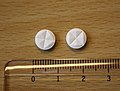 Marcoumar tablets
 -
 Phenprocoumon hydroxylation
 -
 Phenprocoumon enantiomers


-Phenprocoumon_Enantiomers_V.1.svg)
Sponsored Health Resource

W8MD Weight Loss, Sleep & MedSpa
Looking for physician-supervised weight loss, semaglutide, tirzepatide, or GLP-1 receptor agonist options? W8MD helps eligible patients in New York City, Brooklyn, New Jersey, Connecticut, Pennsylvania, Delaware, and greater Philadelphia with medical weight loss, sleep medicine, and long-term maintenance support.
GLP-1 specials: Affordable GLP-1 injections NYC and Philadelphia starting from $29.99/week and up for semaglutide with insurance accepted for qualifying visits, and $45/week and up for tirzepatide with insurance accepted for qualifying visits. Self-pay options start from $59.99/week and up for semaglutide and $69.99/week and up for tirzepatide.
- Medical weight loss NYC
- Affordable GLP-1 injections NYC
- Budget GLP-1 weight loss shots Philadelphia
- New Jersey medical weight loss
- NYC medical weight loss blog
- Philadelphia weight loss blog
- Sleep medicine and sleep apnea services
- W8MD MedSpa and wellness
Book a W8MD appointment · View GLP-1 specials
Paid promotional message. Eligibility, pricing, insurance coverage, medication availability, and results vary. Medical evaluation required.

Medical Disclaimer: WikiMD is for informational purposes only and is not a substitute for professional medical advice. Content may be inaccurate or outdated and should not be used for diagnosis or treatment. Always consult your healthcare provider for medical decisions. Verify information with trusted sources such as CDC.gov and NIH.gov. By using this site, you agree that WikiMD is not liable for any outcomes related to its content. See full disclaimer.
Credits:Most images are courtesy of Wikimedia commons, and templates, categories Wikipedia, licensed under CC BY SA or similar.
Translate page: - East Asian
中文,
日本,
한국어,
South Asian
हिन्दी,
தமிழ்,
తెలుగు,
Urdu,
ಕನ್ನಡ,
Southeast Asian
Indonesian,
Vietnamese,
Thai,
မြန်မာဘာသာ,
বাংলা
European
español,
Deutsch,
français,
Greek,
português do Brasil,
polski,
română,
русский,
Nederlands,
norsk,
svenska,
suomi,
Italian
Middle Eastern & African
عربى,
Turkish,
Persian,
Hebrew,
Afrikaans,
isiZulu,
Kiswahili,
Other
Bulgarian,
Hungarian,
Czech,
Swedish,
മലയാളം,
मराठी,
ਪੰਜਾਬੀ,
ગુજરાતી,
Portuguese,
Ukrainian

