Points of the compass
Points of the compass are directions or positions on a compass, which is a navigational instrument used to determine direction relative to the Earth's magnetic poles. The primary points of the compass are North, South, East, and West. These are often denoted by their initials: N, S, E, and W. The points of the compass are crucial for navigation, map reading, and in various scientific and military contexts.
Primary Points[edit]
The primary points of the compass divide the horizon into four equal parts. These are:
- North (N) - It is the direction that, in the Northern Hemisphere, points towards the North Pole. It is opposite to south.
- South (S) - This direction points towards the South Pole and is opposite to north.
- East (E) - East is the direction perpendicular to north and south and is in the direction of the Earth's rotation.
- West (W) - West is opposite to east and is the direction in which the sun sets.
Secondary Points[edit]
Between the primary points are the secondary points, which are Northeast (NE), Southeast (SE), Southwest (SW), and Northwest (NW). These directions are at an angle of 45 degrees to the primary points and divide the compass into eight directions.
Tertiary and Quaternary Points[edit]
Further divisions can be made to provide even more precise directions. The tertiary points are located halfway between the primary and secondary points, and the quaternary points are located between the primary and tertiary points or secondary and tertiary points. This division results in 16 total directions.
Compass Rose[edit]
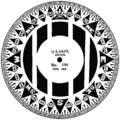
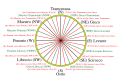
The diagram showing the points of the compass is known as a compass rose. It displays the directions and is often found on maps, nautical charts, and navigation devices. The compass rose has been an essential tool for navigation since the 14th century.
Magnetic Compass[edit]
The magnetic compass is a type of compass that uses the Earth's magnetic field to show direction. The magnetic needle of the compass aligns itself with the Earth's magnetic field, pointing towards the magnetic poles, which are close to but not exactly at the geographical poles.
True North vs. Magnetic North[edit]
True North refers to the direction towards the geographic North Pole, while Magnetic North is the direction the compass needle points, which is towards the Magnetic North Pole. The angle between True North and Magnetic North is known as magnetic declination, which varies depending on location.
[edit]
Understanding the points of the compass is essential for navigation and orientation. It allows individuals to determine their direction of travel, plan routes, and navigate through unfamiliar territories. The points of the compass are also used in various scientific fields, including geology, astronomy, and meteorology, to describe the orientation of features or observations.
Cultural Significance[edit]
The points of the compass have also held significant cultural and symbolic meanings in various civilizations. They are often associated with elements, colors, and spiritual beings in different cultures.

-
 Points of the compass
 -
 Points of the compass
 -
 Points of the compass
 -
 Points of the compass
 -
 Points of the compass
 -
 Points of the compass
 -
 Points of the compass


.svg)

Sponsored Health Resource

W8MD Weight Loss, Sleep & MedSpa
Looking for physician-supervised weight loss, semaglutide, tirzepatide, or GLP-1 receptor agonist options? W8MD helps eligible patients in New York City, Brooklyn, New Jersey, Connecticut, Pennsylvania, Delaware, and greater Philadelphia with medical weight loss, sleep medicine, and long-term maintenance support.
GLP-1 specials: Affordable GLP-1 injections NYC and Philadelphia starting from $29.99/week and up for semaglutide with insurance accepted for qualifying visits, and $45/week and up for tirzepatide with insurance accepted for qualifying visits. Self-pay options start from $59.99/week and up for semaglutide and $69.99/week and up for tirzepatide.
- Medical weight loss NYC
- Affordable GLP-1 injections NYC
- Budget GLP-1 weight loss shots Philadelphia
- New Jersey medical weight loss
- NYC medical weight loss blog
- Philadelphia weight loss blog
- Sleep medicine and sleep apnea services
- W8MD MedSpa and wellness
Book a W8MD appointment · View GLP-1 specials
Paid promotional message. Eligibility, pricing, insurance coverage, medication availability, and results vary. Medical evaluation required.

Medical Disclaimer: WikiMD is for informational purposes only and is not a substitute for professional medical advice. Content may be inaccurate or outdated and should not be used for diagnosis or treatment. Always consult your healthcare provider for medical decisions. Verify information with trusted sources such as CDC.gov and NIH.gov. By using this site, you agree that WikiMD is not liable for any outcomes related to its content. See full disclaimer.
Credits:Most images are courtesy of Wikimedia commons, and templates, categories Wikipedia, licensed under CC BY SA or similar.
Translate page: - East Asian
中文,
日本,
한국어,
South Asian
हिन्दी,
தமிழ்,
తెలుగు,
Urdu,
ಕನ್ನಡ,
Southeast Asian
Indonesian,
Vietnamese,
Thai,
မြန်မာဘာသာ,
বাংলা
European
español,
Deutsch,
français,
Greek,
português do Brasil,
polski,
română,
русский,
Nederlands,
norsk,
svenska,
suomi,
Italian
Middle Eastern & African
عربى,
Turkish,
Persian,
Hebrew,
Afrikaans,
isiZulu,
Kiswahili,
Other
Bulgarian,
Hungarian,
Czech,
Swedish,
മലയാളം,
मराठी,
ਪੰਜਾਬੀ,
ગુજરાતી,
Portuguese,
Ukrainian

