Rubiaceae
Rubiaceae is a family of flowering plants, commonly known as the coffee, madder, or bedstraw family. It consists of terrestrial trees, shrubs, lianas, or herbs that are recognizable by simple, opposite leaves with interpetiolar stipules and sympetalous actinomorphic flowers.
Description[edit]
The Rubiaceae family is characterized by its members' growth form, leaves, stipules, flowers, fruit, and other morphological features. The family is distributed primarily in the tropics, with a few species found in temperate regions.
Growth form[edit]
Members of the Rubiaceae family are mostly evergreen trees and shrubs. Some are lianas, or rarely herbs.
Leaves[edit]
The leaves of the Rubiaceae are simple, undivided, and entire, and are opposite in most cases, with interpetiolar stipules.
Flowers[edit]
The flowers of the Rubiaceae family are usually in an inflorescence that is terminal or axillary and that is cymose or racemose. They are usually actinomorphic and hermaphroditic.
Fruit[edit]
The fruit can be a berry, a capsule, or a nut, and it often contains two seeds (rarely one or more than two).
Taxonomy[edit]
The Rubiaceae family is a large family of flowering plants, including about 611 genera and more than 13,150 species.
Economic importance[edit]
Several members of the family have important economic uses. Coffea species are used to produce coffee, one of the world's most important beverages. Cinchona species are the source of quinine, a treatment for malaria. Some dye plants also belong to this family, including species of Rubia.
See also[edit]
References[edit]

This WikiMD article can only be edited by registered and verified editors. You can log in or register.
Rubiaceae gallery[edit]
-
Luculia gratissima
-
 Alberta magna
 -
Arachnothryx leucophylla
-
 Asperula tinctoria
 -
 Bikkia philippinensis
 -
Chiococca alba
-
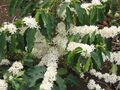 Coffee Flowers
 -
 Galium uliginosum
 -
 Gardenia thunbergia
 -
Ixora coccinea


Medical Disclaimer: WikiMD is for informational purposes only and is not a substitute for professional medical advice. Content may be inaccurate or outdated and should not be used for diagnosis or treatment. Always consult your healthcare provider for medical decisions. Verify information with trusted sources such as CDC.gov and NIH.gov. By using this site, you agree that WikiMD is not liable for any outcomes related to its content. See full disclaimer.
Credits:Most images are courtesy of Wikimedia commons, and templates, categories Wikipedia, licensed under CC BY SA or similar.
Translate page: - East Asian
中文,
日本,
한국어,
South Asian
हिन्दी,
தமிழ்,
తెలుగు,
Urdu,
ಕನ್ನಡ,
Southeast Asian
Indonesian,
Vietnamese,
Thai,
မြန်မာဘာသာ,
বাংলা
European
español,
Deutsch,
français,
Greek,
português do Brasil,
polski,
română,
русский,
Nederlands,
norsk,
svenska,
suomi,
Italian
Middle Eastern & African
عربى,
Turkish,
Persian,
Hebrew,
Afrikaans,
isiZulu,
Kiswahili,
Other
Bulgarian,
Hungarian,
Czech,
Swedish,
മലയാളം,
मराठी,
ਪੰਜਾਬੀ,
ગુજરાતી,
Portuguese,
Ukrainian


