Senna glycoside
Senna Glycoside[edit]
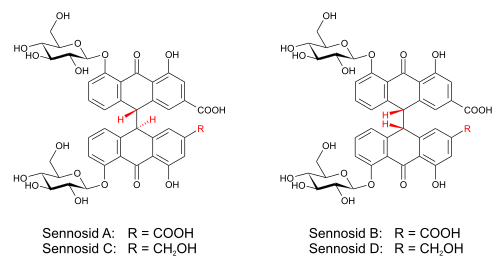
Senna Glycoside[edit]
Senna glycoside, commonly known as sennoside or simply senna, is a medication primarily used for the treatment of constipation and for bowel preparation before surgical procedures. Senna acts as a stimulant laxative, working by increasing the movement of the intestines to help stool pass.
Overview[edit]
Senna glycoside is derived from the leaves and fruit of the senna plant. It is often used in cases of constipation where a softer or bulkier stool is desired, or in clinical settings to clear the large intestine before surgery or certain medical examinations.
Administration[edit]
Senna can be administered:
- Orally: In the form of tablets, capsules, or liquid.
- Rectally: As a suppository or enema for more immediate effect.
Onset of Action[edit]
The onset of action varies depending on the route of administration:
- Rectal: Typically begins working within 30 minutes.
- Oral: Usually takes effect within six to twelve hours.
Comparison with Other Laxatives[edit]
Senna is considered a milder laxative compared to others such as bisacodyl or castor oil. It is often chosen for its relatively gentle action and effectiveness.
Uses[edit]
Senna glycoside is commonly used for:
- Treating occasional constipation.
- Emptying the bowels before procedures like colonoscopies.
- Managing constipation in palliative care settings.
Side Effects[edit]
While generally safe, senna can cause side effects in some individuals, including:
- Abdominal cramps
- Diarrhea
- Nausea
- Changes in urine color (harmless and temporary)
Long-term use or overuse can lead to dependence or changes in electrolyte balance.
Precautions[edit]
Patients are advised to use senna glycoside as directed and consult a healthcare provider for prolonged constipation. It is important to use the appropriate dosage and be aware of potential interactions with other medications.

Sponsored Health Resource

W8MD Weight Loss, Sleep & MedSpa
Looking for physician-supervised weight loss, semaglutide, tirzepatide, or GLP-1 receptor agonist options? W8MD helps eligible patients in New York City, Brooklyn, New Jersey, Connecticut, Pennsylvania, Delaware, and greater Philadelphia with medical weight loss, sleep medicine, and long-term maintenance support.
GLP-1 specials: Affordable GLP-1 injections NYC and Philadelphia starting from $29.99/week and up for semaglutide with insurance accepted for qualifying visits, and $45/week and up for tirzepatide with insurance accepted for qualifying visits. Self-pay options start from $59.99/week and up for semaglutide and $69.99/week and up for tirzepatide.
- Medical weight loss NYC
- Affordable GLP-1 injections NYC
- Budget GLP-1 weight loss shots Philadelphia
- New Jersey medical weight loss
- NYC medical weight loss blog
- Philadelphia weight loss blog
- Sleep medicine and sleep apnea services
- W8MD MedSpa and wellness
Book a W8MD appointment · View GLP-1 specials
Paid promotional message. Eligibility, pricing, insurance coverage, medication availability, and results vary. Medical evaluation required.

Medical Disclaimer: WikiMD is for informational purposes only and is not a substitute for professional medical advice. Content may be inaccurate or outdated and should not be used for diagnosis or treatment. Always consult your healthcare provider for medical decisions. Verify information with trusted sources such as CDC.gov and NIH.gov. By using this site, you agree that WikiMD is not liable for any outcomes related to its content. See full disclaimer.
Credits:Most images are courtesy of Wikimedia commons, and templates, categories Wikipedia, licensed under CC BY SA or similar.
Translate page: - East Asian
中文,
日本,
한국어,
South Asian
हिन्दी,
தமிழ்,
తెలుగు,
Urdu,
ಕನ್ನಡ,
Southeast Asian
Indonesian,
Vietnamese,
Thai,
မြန်မာဘာသာ,
বাংলা
European
español,
Deutsch,
français,
Greek,
português do Brasil,
polski,
română,
русский,
Nederlands,
norsk,
svenska,
suomi,
Italian
Middle Eastern & African
عربى,
Turkish,
Persian,
Hebrew,
Afrikaans,
isiZulu,
Kiswahili,
Other
Bulgarian,
Hungarian,
Czech,
Swedish,
മലയാളം,
मराठी,
ਪੰਜਾਬੀ,
ગુજરાતી,
Portuguese,
Ukrainian

