Syzygium samarangense
Species of flowering plant
Syzygium samarangense, commonly known as the wax apple, love apple, or Java apple, is a species of flowering plant in the Myrtaceae family. It is native to the Malay Peninsula, Andaman and Nicobar Islands, and the Greater Sunda Islands, but has been widely cultivated in other tropical regions.
Description[edit]

Syzygium samarangense is a tropical tree growing to 12 meters tall, with evergreen leaves that are opposite, simple, and elliptic to oblong. The leaves are 10–25 cm long and 5–10 cm wide. The flowers are white, 2.5 cm in diameter, with four petals and numerous stamens.
The fruit is a bell-shaped berry, 4–6 cm long, with a waxy skin that can be pink, red, or white. The flesh is crisp and juicy, with a mild, sweet flavor. The fruit is often eaten fresh or used in salads.
Cultivation[edit]

Syzygium samarangense is cultivated in tropical and subtropical regions around the world. It prefers well-drained soil and a sunny position. The tree is drought-tolerant but benefits from regular watering during dry periods.
Propagation is usually by seed, but grafting and air layering are also used to produce improved cultivars. The tree is relatively pest-free, but can be affected by fruit flies and fungal diseases.
Uses[edit]

The fruit of Syzygium samarangense is consumed fresh, often with a sprinkle of salt or sugar. It is also used in fruit salads and desserts. In some cultures, the fruit is used in traditional medicine to treat various ailments.
The wood of the tree is hard and durable, making it suitable for construction and furniture making.
Cultural significance[edit]
In many tropical regions, Syzygium samarangense is an important fruit tree, both economically and culturally. It is often grown in home gardens and is a common sight in local markets.
Gallery[edit]
-
 Flowers of Syzygium samarangense
 -
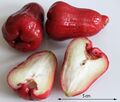 Close-up of the fruit
 -
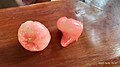 Syzygium samarangense fruit
 -
 Another view of the fruit


Related pages[edit]
Sponsored Health Resource

W8MD Weight Loss, Sleep & MedSpa
Looking for physician-supervised weight loss, semaglutide, tirzepatide, or GLP-1 receptor agonist options? W8MD helps eligible patients in New York City, Brooklyn, New Jersey, Connecticut, Pennsylvania, Delaware, and greater Philadelphia with medical weight loss, sleep medicine, and long-term maintenance support.
GLP-1 specials: Affordable GLP-1 injections NYC and Philadelphia starting from $29.99/week and up for semaglutide with insurance accepted for qualifying visits, and $45/week and up for tirzepatide with insurance accepted for qualifying visits. Self-pay options start from $59.99/week and up for semaglutide and $69.99/week and up for tirzepatide.
- Medical weight loss NYC
- Affordable GLP-1 injections NYC
- Budget GLP-1 weight loss shots Philadelphia
- New Jersey medical weight loss
- NYC medical weight loss blog
- Philadelphia weight loss blog
- Sleep medicine and sleep apnea services
- W8MD MedSpa and wellness
Book a W8MD appointment · View GLP-1 specials
Paid promotional message. Eligibility, pricing, insurance coverage, medication availability, and results vary. Medical evaluation required.

Medical Disclaimer: WikiMD is for informational purposes only and is not a substitute for professional medical advice. Content may be inaccurate or outdated and should not be used for diagnosis or treatment. Always consult your healthcare provider for medical decisions. Verify information with trusted sources such as CDC.gov and NIH.gov. By using this site, you agree that WikiMD is not liable for any outcomes related to its content. See full disclaimer.
Credits:Most images are courtesy of Wikimedia commons, and templates, categories Wikipedia, licensed under CC BY SA or similar.
Translate page: - East Asian
中文,
日本,
한국어,
South Asian
हिन्दी,
தமிழ்,
తెలుగు,
Urdu,
ಕನ್ನಡ,
Southeast Asian
Indonesian,
Vietnamese,
Thai,
မြန်မာဘာသာ,
বাংলা
European
español,
Deutsch,
français,
Greek,
português do Brasil,
polski,
română,
русский,
Nederlands,
norsk,
svenska,
suomi,
Italian
Middle Eastern & African
عربى,
Turkish,
Persian,
Hebrew,
Afrikaans,
isiZulu,
Kiswahili,
Other
Bulgarian,
Hungarian,
Czech,
Swedish,
മലയാളം,
मराठी,
ਪੰਜਾਬੀ,
ગુજરાતી,
Portuguese,
Ukrainian

