White mustard
White Mustard (Sinapis alba) is an annual plant of the family Brassicaceae. It is sometimes also referred to as Brassica alba or B. hirta. Grown for its seeds, mustard, as fodder crop or as a green manure, it is now widespread worldwide, although it probably originated in the Mediterranean region.
Description[edit]
White mustard is an annual, growing to 70 cm high with pinnate leaves. Most are lobed and the plants have an erect stem with yellow flowers that appear from June to September.
Cultivation and uses[edit]
White mustard is commonly used as a cover and green manure crop in Europe (between UK and Ukraine). A large number of varieties exist, e.g. white and brown mustards (Sinapis alba and Brassica juncea respectively) will produce a very large number of seeds per plant and can provide up to 2 tonnes of seed per hectare.
The seeds are a source of mustard condiment. The edible leaves can be used for salad or cooked as a leaf vegetable.
Chemical constituents[edit]
White mustard seeds are a rich source of oil and protein. The seed contains 20 to 30% protein, 25 to 30% lipids, 12 to 16% carbohydrates and 4 to 7% ash. The seeds also contain the glucosinolate sinigrin.
Medicinal use[edit]
In herbal medicine, white mustard is used as a remedy for a number of health disorders. The seeds are recommended as a diuretic in cases of water retention and edema. The seeds are also used to treat bronchitis, rheumatism and neuralgia.
See also[edit]

This WikiMD article can only be edited by registered and verified editors. You can log in or register.
-
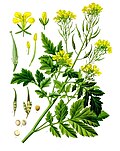 White mustard
 -
 White mustard seeds
 -
 White mustard plant
 -
 White mustard habitat
 -
 White mustard flowers
 -
 White mustard fruits
 -
 White mustard green manuring


.jpg)
Sponsored Health Resource

W8MD Weight Loss, Sleep & MedSpa
Looking for physician-supervised weight loss, semaglutide, tirzepatide, or GLP-1 receptor agonist options? W8MD helps eligible patients in New York City, Brooklyn, New Jersey, Connecticut, Pennsylvania, Delaware, and greater Philadelphia with medical weight loss, sleep medicine, and long-term maintenance support.
GLP-1 specials: Affordable GLP-1 injections NYC and Philadelphia starting from $29.99/week and up for semaglutide with insurance accepted for qualifying visits, and $45/week and up for tirzepatide with insurance accepted for qualifying visits. Self-pay options start from $59.99/week and up for semaglutide and $69.99/week and up for tirzepatide.
- Medical weight loss NYC
- Affordable GLP-1 injections NYC
- Budget GLP-1 weight loss shots Philadelphia
- New Jersey medical weight loss
- NYC medical weight loss blog
- Philadelphia weight loss blog
- Sleep medicine and sleep apnea services
- W8MD MedSpa and wellness
Book a W8MD appointment · View GLP-1 specials
Paid promotional message. Eligibility, pricing, insurance coverage, medication availability, and results vary. Medical evaluation required.

Medical Disclaimer: WikiMD is for informational purposes only and is not a substitute for professional medical advice. Content may be inaccurate or outdated and should not be used for diagnosis or treatment. Always consult your healthcare provider for medical decisions. Verify information with trusted sources such as CDC.gov and NIH.gov. By using this site, you agree that WikiMD is not liable for any outcomes related to its content. See full disclaimer.
Credits:Most images are courtesy of Wikimedia commons, and templates, categories Wikipedia, licensed under CC BY SA or similar.
Translate page: - East Asian
中文,
日本,
한국어,
South Asian
हिन्दी,
தமிழ்,
తెలుగు,
Urdu,
ಕನ್ನಡ,
Southeast Asian
Indonesian,
Vietnamese,
Thai,
မြန်မာဘာသာ,
বাংলা
European
español,
Deutsch,
français,
Greek,
português do Brasil,
polski,
română,
русский,
Nederlands,
norsk,
svenska,
suomi,
Italian
Middle Eastern & African
عربى,
Turkish,
Persian,
Hebrew,
Afrikaans,
isiZulu,
Kiswahili,
Other
Bulgarian,
Hungarian,
Czech,
Swedish,
മലയാളം,
मराठी,
ਪੰਜਾਬੀ,
ગુજરાતી,
Portuguese,
Ukrainian

