Zygomycota
A division of fungi known for their fast-growing nature and diverse habitats
Overview[edit]
Zygomycota is a division of fungi characterized by the formation of a unique reproductive structure called a zygospore. These fungi are primarily terrestrial in habitat, thriving in soil, decaying plant material, and animal dung. They are known for their rapid growth and ability to colonize a variety of substrates.
Morphology[edit]
Zygomycota fungi typically exhibit a coenocytic mycelium, meaning their hyphae lack septa, or cross-walls, except when forming reproductive structures. The hyphae are usually haploid, and the cell walls are composed of chitin.
Reproductive Structures[edit]
The defining feature of Zygomycota is the production of zygospores during sexual reproduction. Zygospores are thick-walled, resistant spores formed by the fusion of two compatible hyphae. In asexual reproduction, these fungi produce sporangiospores within a sporangium, which is borne on a sporangiophore.
Ecology[edit]
Zygomycota play a crucial role in ecosystems as decomposers, breaking down complex organic materials into simpler compounds. Some species are also involved in symbiotic relationships, such as mycorrhizal associations with plants, where they enhance nutrient uptake for the host plant.
Pathogenicity[edit]
While most Zygomycota are harmless saprophytes, some species can cause infections in humans and animals, particularly in immunocompromised individuals. These infections, known as zygomycosis, can be severe and require medical intervention.
Economic Importance[edit]
Zygomycota have significant economic importance. They are used in the production of various fermented foods and beverages. Additionally, some species are utilized in the production of organic acids and enzymes in industrial processes.
Examples of Zygomycota[edit]
- Rhizopus - Commonly known as black bread mold, it is a well-known example of Zygomycota.
- Mucor - Often found in soil and decaying organic matter, it is another representative genus.
- Pilobolus - Known for its phototropic sporangiophores, it grows on herbivore dung.
Related pages[edit]
Zygomycota[edit]
-
 Phycomyces
 -
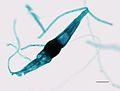 Zygo1005
 -
 Pin Mould on Peach High Mag Scale
 -
 Life cycle, Mucor sp., Mucorales, Zygomycota
 -
 Sporangium
 -
 Cell wall structure of Fungi
 -
 Postulated biosynthesis of trisporic acid B
 -
 Bending angle in vertical sporangiophore
 -
 Lipid globules and protein crystals in sporangiophore
 -
 Zygomycetes on solid media
 -
 Zygomycetes on Sub-media, in light and non-light condition


.svg)


.png)


Sponsored Health Resource

W8MD Weight Loss, Sleep & MedSpa
Looking for physician-supervised weight loss, semaglutide, tirzepatide, or GLP-1 receptor agonist options? W8MD helps eligible patients in New York City, Brooklyn, New Jersey, Connecticut, Pennsylvania, Delaware, and greater Philadelphia with medical weight loss, sleep medicine, and long-term maintenance support.
GLP-1 specials: Affordable GLP-1 injections NYC and Philadelphia starting from $29.99/week and up for semaglutide with insurance accepted for qualifying visits, and $45/week and up for tirzepatide with insurance accepted for qualifying visits. Self-pay options start from $59.99/week and up for semaglutide and $69.99/week and up for tirzepatide.
- Medical weight loss NYC
- Affordable GLP-1 injections NYC
- Budget GLP-1 weight loss shots Philadelphia
- New Jersey medical weight loss
- NYC medical weight loss blog
- Philadelphia weight loss blog
- Sleep medicine and sleep apnea services
- W8MD MedSpa and wellness
Book a W8MD appointment · View GLP-1 specials
Paid promotional message. Eligibility, pricing, insurance coverage, medication availability, and results vary. Medical evaluation required.

Medical Disclaimer: WikiMD is for informational purposes only and is not a substitute for professional medical advice. Content may be inaccurate or outdated and should not be used for diagnosis or treatment. Always consult your healthcare provider for medical decisions. Verify information with trusted sources such as CDC.gov and NIH.gov. By using this site, you agree that WikiMD is not liable for any outcomes related to its content. See full disclaimer.
Credits:Most images are courtesy of Wikimedia commons, and templates, categories Wikipedia, licensed under CC BY SA or similar.
Translate page: - East Asian
中文,
日本,
한국어,
South Asian
हिन्दी,
தமிழ்,
తెలుగు,
Urdu,
ಕನ್ನಡ,
Southeast Asian
Indonesian,
Vietnamese,
Thai,
မြန်မာဘာသာ,
বাংলা
European
español,
Deutsch,
français,
Greek,
português do Brasil,
polski,
română,
русский,
Nederlands,
norsk,
svenska,
suomi,
Italian
Middle Eastern & African
عربى,
Turkish,
Persian,
Hebrew,
Afrikaans,
isiZulu,
Kiswahili,
Other
Bulgarian,
Hungarian,
Czech,
Swedish,
മലയാളം,
मराठी,
ਪੰਜਾਬੀ,
ગુજરાતી,
Portuguese,
Ukrainian

