Proper palmar digital arteries
The proper palmar digital arteries are a network of arteries located in the palm of the hand. They are responsible for supplying oxygenated blood to the fingers and the adjacent structures. In this article, we will explore the anatomy, function, and clinical significance of the proper palmar digital arteries.
Anatomy[edit]
The proper palmar digital arteries arise from the superficial palmar arch, which is formed by the ulnar artery and the superficial branch of the radial artery. The superficial palmar arch is located in the palm of the hand, just deep to the palmar aponeurosis.
From the superficial palmar arch, the proper palmar digital arteries branch out and travel along the sides of the fingers. There are four proper palmar digital arteries in total, one for each finger. These arteries give rise to smaller branches called the common palmar digital arteries, which further divide into proper palmar digital arteries proper to each finger.
Function[edit]
The main function of the proper palmar digital arteries is to supply oxygenated blood to the fingers. As the arteries travel along the sides of the fingers, they give off smaller branches that penetrate the finger pulp and supply blood to the tissues of the fingers.
The blood supplied by the proper palmar digital arteries is essential for the nourishment and oxygenation of the finger tissues. It provides the necessary nutrients and oxygen for the cells to carry out their metabolic activities. Additionally, the arterial blood flow helps maintain the temperature of the fingers and aids in the removal of waste products.
Clinical Significance[edit]
The proper palmar digital arteries can be affected by various pathological conditions, leading to potential clinical significance. Some of these conditions include:
1. Arterial occlusion: Occlusion or blockage of the proper palmar digital arteries can result in reduced blood flow to the fingers. This can lead to ischemia, causing symptoms such as pain, numbness, and coldness in the affected finger.
2. Thrombosis: Thrombosis refers to the formation of a blood clot within the proper palmar digital arteries. This can obstruct blood flow and result in similar symptoms as arterial occlusion.
3. Aneurysm: An aneurysm is a localized dilation or bulging of an artery. If an aneurysm occurs in one of the proper palmar digital arteries, it can lead to pain, swelling, and potential rupture.
4. Trauma: Traumatic injuries to the hand can damage the proper palmar digital arteries, leading to bleeding and potential complications. Prompt medical attention is necessary to control bleeding and restore blood flow.
Conclusion[edit]
The proper palmar digital arteries play a crucial role in supplying oxygenated blood to the fingers. Understanding their anatomy, function, and clinical significance is essential for healthcare professionals involved in hand-related conditions. Proper assessment and management of any abnormalities or injuries involving these arteries are crucial for maintaining hand function and overall hand health.
See Also[edit]
-
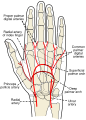 Proper palmar digital arteries
 -
 Slide 1


Sponsored Health Resource

W8MD Weight Loss, Sleep & MedSpa
Looking for physician-supervised weight loss, semaglutide, tirzepatide, or GLP-1 receptor agonist options? W8MD helps eligible patients in New York City, Brooklyn, New Jersey, Connecticut, Pennsylvania, Delaware, and greater Philadelphia with medical weight loss, sleep medicine, and long-term maintenance support.
GLP-1 specials: Affordable GLP-1 injections NYC and Philadelphia starting from $29.99/week and up for semaglutide with insurance accepted for qualifying visits, and $45/week and up for tirzepatide with insurance accepted for qualifying visits. Self-pay options start from $59.99/week and up for semaglutide and $69.99/week and up for tirzepatide.
- Medical weight loss NYC
- Affordable GLP-1 injections NYC
- Budget GLP-1 weight loss shots Philadelphia
- New Jersey medical weight loss
- NYC medical weight loss blog
- Philadelphia weight loss blog
- Sleep medicine and sleep apnea services
- W8MD MedSpa and wellness
Book a W8MD appointment · View GLP-1 specials
Paid promotional message. Eligibility, pricing, insurance coverage, medication availability, and results vary. Medical evaluation required.

Medical Disclaimer: WikiMD is for informational purposes only and is not a substitute for professional medical advice. Content may be inaccurate or outdated and should not be used for diagnosis or treatment. Always consult your healthcare provider for medical decisions. Verify information with trusted sources such as CDC.gov and NIH.gov. By using this site, you agree that WikiMD is not liable for any outcomes related to its content. See full disclaimer.
Credits:Most images are courtesy of Wikimedia commons, and templates, categories Wikipedia, licensed under CC BY SA or similar.
Translate page: - East Asian
中文,
日本,
한국어,
South Asian
हिन्दी,
தமிழ்,
తెలుగు,
Urdu,
ಕನ್ನಡ,
Southeast Asian
Indonesian,
Vietnamese,
Thai,
မြန်မာဘာသာ,
বাংলা
European
español,
Deutsch,
français,
Greek,
português do Brasil,
polski,
română,
русский,
Nederlands,
norsk,
svenska,
suomi,
Italian
Middle Eastern & African
عربى,
Turkish,
Persian,
Hebrew,
Afrikaans,
isiZulu,
Kiswahili,
Other
Bulgarian,
Hungarian,
Czech,
Swedish,
മലയാളം,
मराठी,
ਪੰਜਾਬੀ,
ગુજરાતી,
Portuguese,
Ukrainian

