Biological pump
The biological pump, also known as the marine biological pump, is a process that transports carbon from the Earth's surface to the deep ocean. This process plays a crucial role in the global carbon cycle, as it helps to regulate the concentration of carbon dioxide in the Earth's atmosphere.
Overview[edit]
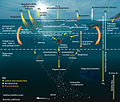
The biological pump is driven by the production of organic matter by photosynthetic organisms in the surface ocean, primarily phytoplankton. These organisms convert carbon dioxide and sunlight into organic matter and oxygen through the process of photosynthesis. When these organisms die or are consumed by other organisms, the organic matter they contain can sink to the deep ocean, where it is sequestered from the atmosphere for hundreds to thousands of years.
Components of the Biological Pump[edit]
The biological pump consists of two main components: the soft-tissue pump and the carbonate pump.
Soft-Tissue Pump[edit]
The soft-tissue pump involves the production of organic matter by photosynthetic organisms in the surface ocean, and its subsequent transport to the deep ocean. This process begins with the uptake of carbon dioxide by phytoplankton, which convert it into organic matter through photosynthesis. When these organisms die or are consumed by other organisms, the organic matter they contain can sink to the deep ocean as marine snow.
Carbonate Pump[edit]
The carbonate pump involves the production of calcium carbonate shells by certain types of plankton, such as coccolithophores and foraminifera. When these organisms die, their shells sink to the deep ocean, where they can contribute to the formation of carbonate sediments.
Role in the Carbon Cycle[edit]
The biological pump plays a crucial role in the global carbon cycle. By transporting carbon from the surface ocean to the deep ocean, it helps to regulate the concentration of carbon dioxide in the Earth's atmosphere. This process is particularly important in the context of climate change, as it can help to mitigate the increase in atmospheric carbon dioxide concentrations caused by human activities.
See Also[edit]
 | This oceanography article is a stub. You can help WikiMD by expanding the page. |
This climate change related article is a stub. You can help WikiMD by expanding it.
-
 WOA05 GLODAP invt aco2 AYool
 -
Vertically integrated anthropogenic dissolved inorganic carbon 1990s (GLODAP)
-
 Oceanic Food Web
 -
 Components of the biological pump 2018
 -
 Components of the biological pump
 -
 Size and classification of marine particles
 -
 Marine connections between the living and the nonliving
 -
 Fate of DOM in the ocean
.png)


Sponsored Health Resource

W8MD Weight Loss, Sleep & MedSpa
Looking for physician-supervised weight loss, semaglutide, tirzepatide, or GLP-1 receptor agonist options? W8MD helps eligible patients in New York City, Brooklyn, New Jersey, Connecticut, Pennsylvania, Delaware, and greater Philadelphia with medical weight loss, sleep medicine, and long-term maintenance support.
GLP-1 specials: Affordable GLP-1 injections NYC and Philadelphia starting from $29.99/week and up for semaglutide with insurance accepted for qualifying visits, and $45/week and up for tirzepatide with insurance accepted for qualifying visits. Self-pay options start from $59.99/week and up for semaglutide and $69.99/week and up for tirzepatide.
- Medical weight loss NYC
- Affordable GLP-1 injections NYC
- Budget GLP-1 weight loss shots Philadelphia
- New Jersey medical weight loss
- NYC medical weight loss blog
- Philadelphia weight loss blog
- Sleep medicine and sleep apnea services
- W8MD MedSpa and wellness
Book a W8MD appointment · View GLP-1 specials
Paid promotional message. Eligibility, pricing, insurance coverage, medication availability, and results vary. Medical evaluation required.

Medical Disclaimer: WikiMD is for informational purposes only and is not a substitute for professional medical advice. Content may be inaccurate or outdated and should not be used for diagnosis or treatment. Always consult your healthcare provider for medical decisions. Verify information with trusted sources such as CDC.gov and NIH.gov. By using this site, you agree that WikiMD is not liable for any outcomes related to its content. See full disclaimer.
Credits:Most images are courtesy of Wikimedia commons, and templates, categories Wikipedia, licensed under CC BY SA or similar.
Translate page: - East Asian
中文,
日本,
한국어,
South Asian
हिन्दी,
தமிழ்,
తెలుగు,
Urdu,
ಕನ್ನಡ,
Southeast Asian
Indonesian,
Vietnamese,
Thai,
မြန်မာဘာသာ,
বাংলা
European
español,
Deutsch,
français,
Greek,
português do Brasil,
polski,
română,
русский,
Nederlands,
norsk,
svenska,
suomi,
Italian
Middle Eastern & African
عربى,
Turkish,
Persian,
Hebrew,
Afrikaans,
isiZulu,
Kiswahili,
Other
Bulgarian,
Hungarian,
Czech,
Swedish,
മലയാളം,
मराठी,
ਪੰਜਾਬੀ,
ગુજરાતી,
Portuguese,
Ukrainian

