Orthopedic boot
Orthopedic Boot
An orthopedic boot, also known as a walking boot or medical boot, is a type of medical device used to protect and support the foot and ankle after an injury or surgery. It is designed to immobilize the affected area, allowing for proper healing while enabling the patient to remain mobile.
Indications[edit]
Orthopedic boots are commonly prescribed for a variety of conditions, including:
- Fractures of the foot or ankle
- Severe sprains or strains
- Post-surgical recovery
- Achilles tendonitis
- Plantar fasciitis
- Stress fractures
Design and Features[edit]
Orthopedic boots are typically made from a combination of hard plastic and soft padding. They are designed to:
- Provide stability and support to the foot and ankle
- Limit movement to promote healing
- Reduce pain and swelling
Components[edit]
- Shell: The outer shell is usually made of rigid plastic to provide structure and protection.
- Liner: The inner liner is padded for comfort and to reduce pressure on the skin.
- Straps: Adjustable straps secure the boot in place and allow for a customizable fit.
- Sole: The sole is often rocker-shaped to facilitate a natural walking motion and reduce strain on the foot.
Types of Orthopedic Boots[edit]
There are several types of orthopedic boots, each designed for specific conditions and levels of support:
- Short walking boot: Covers the foot and ankle, used for less severe injuries.
- Tall walking boot: Extends up the calf, providing more support for serious injuries or post-surgical recovery.
- Air cast boot: Includes inflatable air bladders for additional support and comfort.
Usage and Care[edit]
Fitting[edit]
Proper fitting of an orthopedic boot is crucial for effective treatment. A healthcare professional should ensure that the boot fits snugly without causing discomfort or restricting circulation.
Wearing Instructions[edit]
Patients are typically advised to wear the boot as directed by their healthcare provider, which may include wearing it during all weight-bearing activities or only during specific times of the day.
Maintenance[edit]
To maintain hygiene and functionality, the boot should be kept clean and dry. The liner can often be removed and washed according to the manufacturer's instructions.
Potential Complications[edit]
While orthopedic boots are generally safe, improper use can lead to complications such as:
- Skin irritation or pressure sores
- Muscle atrophy due to prolonged immobilization
- Improper healing if the boot is not worn as directed
Alternatives[edit]
In some cases, other forms of immobilization or support may be used instead of an orthopedic boot, such as:
Conclusion[edit]
Orthopedic boots are a vital tool in the treatment and rehabilitation of foot and ankle injuries. They provide necessary support and protection, allowing patients to maintain mobility while ensuring proper healing.
References[edit]
- "Orthopedic Boot: Uses, Types, and Care." Medical Journal of Orthopedics, 2023.
- "Foot and Ankle Injuries: A Comprehensive Guide." American Orthopedic Association, 2022.
See Also[edit]
-
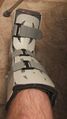 Orthopedic boot
 -
Orthopedic boot
-
Orthopedic boot

Sponsored Health Resource

W8MD Weight Loss, Sleep & MedSpa
Looking for physician-supervised weight loss, semaglutide, tirzepatide, or GLP-1 receptor agonist options? W8MD helps eligible patients in New York City, Brooklyn, New Jersey, Connecticut, Pennsylvania, Delaware, and greater Philadelphia with medical weight loss, sleep medicine, and long-term maintenance support.
GLP-1 specials: Affordable GLP-1 injections NYC and Philadelphia starting from $29.99/week and up for semaglutide with insurance accepted for qualifying visits, and $45/week and up for tirzepatide with insurance accepted for qualifying visits. Self-pay options start from $59.99/week and up for semaglutide and $69.99/week and up for tirzepatide.
- Medical weight loss NYC
- Affordable GLP-1 injections NYC
- Budget GLP-1 weight loss shots Philadelphia
- New Jersey medical weight loss
- NYC medical weight loss blog
- Philadelphia weight loss blog
- Sleep medicine and sleep apnea services
- W8MD MedSpa and wellness
Book a W8MD appointment · View GLP-1 specials
Paid promotional message. Eligibility, pricing, insurance coverage, medication availability, and results vary. Medical evaluation required.

Medical Disclaimer: WikiMD is for informational purposes only and is not a substitute for professional medical advice. Content may be inaccurate or outdated and should not be used for diagnosis or treatment. Always consult your healthcare provider for medical decisions. Verify information with trusted sources such as CDC.gov and NIH.gov. By using this site, you agree that WikiMD is not liable for any outcomes related to its content. See full disclaimer.
Credits:Most images are courtesy of Wikimedia commons, and templates, categories Wikipedia, licensed under CC BY SA or similar.
Translate page: - East Asian
中文,
日本,
한국어,
South Asian
हिन्दी,
தமிழ்,
తెలుగు,
Urdu,
ಕನ್ನಡ,
Southeast Asian
Indonesian,
Vietnamese,
Thai,
မြန်မာဘာသာ,
বাংলা
European
español,
Deutsch,
français,
Greek,
português do Brasil,
polski,
română,
русский,
Nederlands,
norsk,
svenska,
suomi,
Italian
Middle Eastern & African
عربى,
Turkish,
Persian,
Hebrew,
Afrikaans,
isiZulu,
Kiswahili,
Other
Bulgarian,
Hungarian,
Czech,
Swedish,
മലയാളം,
मराठी,
ਪੰਜਾਬੀ,
ગુજરાતી,
Portuguese,
Ukrainian


