Adhesive bandage
Adhesive bandage[edit]
An adhesive bandage, also known as a plaster or band-aid, is a small medical dressing used for injuries not serious enough to require a full-size bandage. It protects the wound and scab from friction, bacteria, damage, and dirt. This assists the healing process.
Components[edit]
An adhesive bandage consists of several components:
- Adhesive strip: A flexible strip that adheres to the skin, usually made of fabric, plastic, or latex.
- Absorbent pad: A small pad in the center of the adhesive strip that covers the wound. It is often made of cotton and is designed to absorb blood and exudate.
- Release liner: A protective layer that covers the adhesive side of the bandage until it is ready to be used.
Types[edit]
There are various types of adhesive bandages designed for different purposes:
- Standard adhesive bandages: Used for minor cuts and abrasions.
- Butterfly closures: Used to close small wounds and incisions, providing support to the skin.
- Hydrocolloid bandages: Used for blisters and burns, providing a moist environment to promote healing.
Uses[edit]
Adhesive bandages are used to:
- Protect cuts and abrasions from infection.
- Keep wounds clean and dry.
- Provide a barrier against bacteria and dirt.
- Support the healing process by maintaining a moist environment.
Application[edit]
To apply an adhesive bandage:
1. Clean the wound with water and mild soap. 2. Dry the area thoroughly. 3. Remove the release liner from the adhesive bandage. 4. Place the absorbent pad over the wound. 5. Press the adhesive strip onto the skin, ensuring it is secure.
History[edit]
The adhesive bandage was invented in 1920 by Earle Dickson, an employee of Johnson & Johnson. He created it to help his wife, who frequently cut herself while cooking. The product was later mass-produced and became widely popular.
Related pages[edit]
Gallery[edit]
-
 A standard adhesive bandage.
 -
 Adhesive bandages in various sizes.
 -
 A close-up of an adhesive bandage.
 -
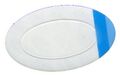 A hydrocolloid bandage for blisters.
 -
 A butterfly closure for wound support.


Sponsored Health Resource

W8MD Weight Loss, Sleep & MedSpa
Looking for physician-supervised weight loss, semaglutide, tirzepatide, or GLP-1 receptor agonist options? W8MD helps eligible patients in New York City, Brooklyn, New Jersey, Connecticut, Pennsylvania, Delaware, and greater Philadelphia with medical weight loss, sleep medicine, and long-term maintenance support.
GLP-1 specials: Affordable GLP-1 injections NYC and Philadelphia starting from $29.99/week and up for semaglutide with insurance accepted for qualifying visits, and $45/week and up for tirzepatide with insurance accepted for qualifying visits. Self-pay options start from $59.99/week and up for semaglutide and $69.99/week and up for tirzepatide.
- Medical weight loss NYC
- Affordable GLP-1 injections NYC
- Budget GLP-1 weight loss shots Philadelphia
- New Jersey medical weight loss
- NYC medical weight loss blog
- Philadelphia weight loss blog
- Sleep medicine and sleep apnea services
- W8MD MedSpa and wellness
Book a W8MD appointment · View GLP-1 specials
Paid promotional message. Eligibility, pricing, insurance coverage, medication availability, and results vary. Medical evaluation required.

Medical Disclaimer: WikiMD is for informational purposes only and is not a substitute for professional medical advice. Content may be inaccurate or outdated and should not be used for diagnosis or treatment. Always consult your healthcare provider for medical decisions. Verify information with trusted sources such as CDC.gov and NIH.gov. By using this site, you agree that WikiMD is not liable for any outcomes related to its content. See full disclaimer.
Credits:Most images are courtesy of Wikimedia commons, and templates, categories Wikipedia, licensed under CC BY SA or similar.
Translate page: - East Asian
中文,
日本,
한국어,
South Asian
हिन्दी,
தமிழ்,
తెలుగు,
Urdu,
ಕನ್ನಡ,
Southeast Asian
Indonesian,
Vietnamese,
Thai,
မြန်မာဘာသာ,
বাংলা
European
español,
Deutsch,
français,
Greek,
português do Brasil,
polski,
română,
русский,
Nederlands,
norsk,
svenska,
suomi,
Italian
Middle Eastern & African
عربى,
Turkish,
Persian,
Hebrew,
Afrikaans,
isiZulu,
Kiswahili,
Other
Bulgarian,
Hungarian,
Czech,
Swedish,
മലയാളം,
मराठी,
ਪੰਜਾਬੀ,
ગુજરાતી,
Portuguese,
Ukrainian

