Founder effect
Founder effect is a concept in genetics that refers to the loss of genetic variation that occurs when a new population is established by a very small number of individuals from a larger population. This can lead to a reduced genetic diversity in the new population, as well as an increased likelihood of certain genetic disorders and diseases.
Overview[edit]
The founder effect is a special case of genetic drift, a random change in the frequency of alleles in a population due to chance events. When a small group of individuals leaves a larger population to establish a new one, they carry with them only a small fraction of the original population's genetic diversity. This can lead to a higher frequency of certain alleles in the new population, which can in turn increase the likelihood of certain genetic disorders and diseases.
Causes[edit]
The founder effect can occur in a number of ways. One common cause is geographical isolation, where a small group of individuals becomes separated from the larger population and establishes a new one in a different location. Another cause can be cultural isolation, where a small group of individuals separates from the larger population due to cultural differences or practices.
Effects[edit]
The effects of the founder effect can be significant. The reduced genetic diversity can make the new population more susceptible to certain diseases and disorders. It can also lead to a higher frequency of certain traits, which can have both positive and negative effects on the population's survival and reproduction.
Examples[edit]
There are many examples of the founder effect in both human and animal populations. One well-known example is the Amish population in the United States, which has a higher frequency of certain genetic disorders due to the small number of founders. Another example is the cheetah population, which has a very low genetic diversity due to a bottleneck event in its past.
See also[edit]
References[edit]

This WikiMD article can only be edited by registered and verified editors. You can log in or register.
-
 Founder effect diagram
 -
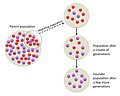 Illustration of the founder effect


Medical Disclaimer: WikiMD is for informational purposes only and is not a substitute for professional medical advice. Content may be inaccurate or outdated and should not be used for diagnosis or treatment. Always consult your healthcare provider for medical decisions. Verify information with trusted sources such as CDC.gov and NIH.gov. By using this site, you agree that WikiMD is not liable for any outcomes related to its content. See full disclaimer.
Credits:Most images are courtesy of Wikimedia commons, and templates, categories Wikipedia, licensed under CC BY SA or similar.
Translate page: - East Asian
中文,
日本,
한국어,
South Asian
हिन्दी,
தமிழ்,
తెలుగు,
Urdu,
ಕನ್ನಡ,
Southeast Asian
Indonesian,
Vietnamese,
Thai,
မြန်မာဘာသာ,
বাংলা
European
español,
Deutsch,
français,
Greek,
português do Brasil,
polski,
română,
русский,
Nederlands,
norsk,
svenska,
suomi,
Italian
Middle Eastern & African
عربى,
Turkish,
Persian,
Hebrew,
Afrikaans,
isiZulu,
Kiswahili,
Other
Bulgarian,
Hungarian,
Czech,
Swedish,
മലയാളം,
मराठी,
ਪੰਜਾਬੀ,
ગુજરાતી,
Portuguese,
Ukrainian

