Gas chromatography
Gas chromatography (GC) is a common type of chromatography used in analytical chemistry for separating and analyzing compounds that can be vaporized without decomposition. This technique is typically used for testing the purity of a particular substance, or separating the different components of a mixture. In some situations, GC may help in identifying a compound.
Principle[edit]
Gas chromatography is in principle similar to column chromatography, but has several notable differences. The sample solution injected into the instrument enters a gas stream which transports the sample into a separation tube known as the "column." Helium or nitrogen is used as the carrier gas to transport the molecules through the column.
Components[edit]
A gas chromatograph is a chemical analysis instrument for separating chemicals in a complex sample. A gas chromatograph uses a flow-through narrow tube known as the column, through which different chemical constituents of a sample pass in a gas stream (carrier gas) at different rates depending on their various chemical and physical properties and their interaction with a specific column filling, called the stationary phase.
Injector[edit]
The injector serves to introduce the sample into the continuous flow of carrier gas. The injector should introduce the sample in a reproducible manner and without causing sample decomposition.
Column[edit]
The column is where the components are separated; it is the heart of the system. The column can be packed or capillary. Packed columns are the routine and economical option, and are still widely used for routine analyses.
Detector[edit]
The detector is the device that sees the separated components; it provides a signal proportional to the amount of sample component emerging from the column. Hence, the detector is the sensing portion of the system.
Applications[edit]
Gas chromatography is widely used in applications involving pharmaceuticals, food chemistry, fire investigation, environmental analysis, and explosives investigation. It is also used in the advancement of medicine, science, and technology.
See also[edit]

This WikiMD article can only be edited by registered and verified editors. You can log in or register.
-
 Gas chromatograph vector diagram
 -
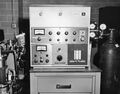 Historical gas chromatograph
 -
 Microsyringe based autosampler
 -
 Split/splitless injector diagram
 -
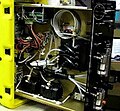 Gas chromatography equipment setup
 -
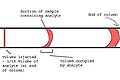 GC rule of 10
 -
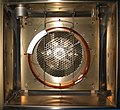 Inside of a GC oven

_-_DPLA_-_6f678040232669661dcfb95308013cc0.jpg)


Sponsored Health Resource

W8MD Weight Loss, Sleep & MedSpa
Looking for physician-supervised weight loss, semaglutide, tirzepatide, or GLP-1 receptor agonist options? W8MD helps eligible patients in New York City, Brooklyn, New Jersey, Connecticut, Pennsylvania, Delaware, and greater Philadelphia with medical weight loss, sleep medicine, and long-term maintenance support.
GLP-1 specials: Affordable GLP-1 injections NYC and Philadelphia starting from $29.99/week and up for semaglutide with insurance accepted for qualifying visits, and $45/week and up for tirzepatide with insurance accepted for qualifying visits. Self-pay options start from $59.99/week and up for semaglutide and $69.99/week and up for tirzepatide.
- Medical weight loss NYC
- Affordable GLP-1 injections NYC
- Budget GLP-1 weight loss shots Philadelphia
- New Jersey medical weight loss
- NYC medical weight loss blog
- Philadelphia weight loss blog
- Sleep medicine and sleep apnea services
- W8MD MedSpa and wellness
Book a W8MD appointment · View GLP-1 specials
Paid promotional message. Eligibility, pricing, insurance coverage, medication availability, and results vary. Medical evaluation required.

Medical Disclaimer: WikiMD is for informational purposes only and is not a substitute for professional medical advice. Content may be inaccurate or outdated and should not be used for diagnosis or treatment. Always consult your healthcare provider for medical decisions. Verify information with trusted sources such as CDC.gov and NIH.gov. By using this site, you agree that WikiMD is not liable for any outcomes related to its content. See full disclaimer.
Credits:Most images are courtesy of Wikimedia commons, and templates, categories Wikipedia, licensed under CC BY SA or similar.
Translate page: - East Asian
中文,
日本,
한국어,
South Asian
हिन्दी,
தமிழ்,
తెలుగు,
Urdu,
ಕನ್ನಡ,
Southeast Asian
Indonesian,
Vietnamese,
Thai,
မြန်မာဘာသာ,
বাংলা
European
español,
Deutsch,
français,
Greek,
português do Brasil,
polski,
română,
русский,
Nederlands,
norsk,
svenska,
suomi,
Italian
Middle Eastern & African
عربى,
Turkish,
Persian,
Hebrew,
Afrikaans,
isiZulu,
Kiswahili,
Other
Bulgarian,
Hungarian,
Czech,
Swedish,
മലയാളം,
मराठी,
ਪੰਜਾਬੀ,
ગુજરાતી,
Portuguese,
Ukrainian

