Hypothalamus
Hypothalamus is a small region of the brain that serves as the main control center for many functions of the autonomic nervous system. It plays a crucial role in many important functions, including releasing hormones, regulating body temperature and maintaining daily physiological cycles.
Function[edit]
The hypothalamus is responsible for the regulation of certain metabolic processes and other activities of the Autonomic Nervous System. It synthesizes and secretes certain neurohormones, often called hypothalamic-releasing hormones, and these in turn stimulate or inhibit the secretion of pituitary hormones.
Anatomy[edit]
The hypothalamus is located below the thalamus and right above the brain stem. It forms the ventral part of the diencephalon. All vertebrate brains contain a hypothalamus. In humans, it is roughly the size of an almond.
Hypothalamic Hormones[edit]
The hypothalamus produces several releasing and inhibiting hormones that act on the pituitary gland, signaling it to release hormones that affect growth, mood, and the reproductive cycle.
Disorders[edit]
Disorders of the hypothalamus can lead to a range of problems. For example, damage to the hypothalamus may result in disruptions to the body’s thermoregulation, causing hypothermia or hyperthermia. Other disorders include hypopituitarism, hypothyroidism, and diabetes insipidus.
See Also[edit]
References[edit]

This WikiMD article can only be edited by registered and verified editors. You can log in or register.
-
 Hypothalamus
 -
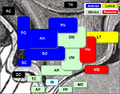 Hypothalamic nuclei
 -
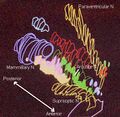 3D view of the hypothalamus
 -
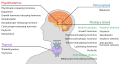 Endocrine and central nervous system
 -
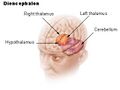 Illustration of the diencephalon
 -
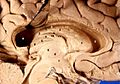 Dissected midsagittal view of the human brain
 -
 Location of the hypothalamus


Medical Disclaimer: WikiMD is for informational purposes only and is not a substitute for professional medical advice. Content may be inaccurate or outdated and should not be used for diagnosis or treatment. Always consult your healthcare provider for medical decisions. Verify information with trusted sources such as CDC.gov and NIH.gov. By using this site, you agree that WikiMD is not liable for any outcomes related to its content. See full disclaimer.
Credits:Most images are courtesy of Wikimedia commons, and templates, categories Wikipedia, licensed under CC BY SA or similar.
Translate page: - East Asian
中文,
日本,
한국어,
South Asian
हिन्दी,
தமிழ்,
తెలుగు,
Urdu,
ಕನ್ನಡ,
Southeast Asian
Indonesian,
Vietnamese,
Thai,
မြန်မာဘာသာ,
বাংলা
European
español,
Deutsch,
français,
Greek,
português do Brasil,
polski,
română,
русский,
Nederlands,
norsk,
svenska,
suomi,
Italian
Middle Eastern & African
عربى,
Turkish,
Persian,
Hebrew,
Afrikaans,
isiZulu,
Kiswahili,
Other
Bulgarian,
Hungarian,
Czech,
Swedish,
മലയാളം,
मराठी,
ਪੰਜਾਬੀ,
ગુજરાતી,
Portuguese,
Ukrainian

