Logarithmic scale
A Logarithmic scale is a nonlinear scale used when there is a large range of quantities. Common uses include earthquake strength, sound loudness, light intensity, and pH of solutions.
Overview[edit]
In a logarithmic scale, each tick mark on the scale is the previous tick mark multiplied by a value. Logarithmic scales are also used in slide rules for multiplying or dividing numbers by adding or subtracting lengths on the scales.
The decibel and the pH scale are logarithmic scales. What these scales have in common is that each step of equal distance from the last is a multiplication by the same factor, for example 10.
Mathematical basis[edit]
The logarithm to base b of a number x is the inverse function of b to the power x. In other words, if y = logb(x), then x = by. In the equation y = logb(x), the base b could be any positive number except 1, although often the base is 10, especially in scientific usage, or the base is the transcendental number e, especially in mathematical and some scientific usage.
Applications[edit]
Logarithmic scales are used in many areas of science and engineering:
- Decibels measure sound intensity
- pH measures the acidity or alkalinity of a solution
- Richter scale and moment magnitude scale measure earthquakes
- Logarithms are used in computing to reduce multiplication operations to addition and division to subtraction.
See also[edit]
- Exponential growth
- Semi-log plot
- Logarithmic mean
- Bode plot
- Level (logarithmic quantity)
- Logarithmic timeline
- Logarithmic video amplification

This WikiMD article can only be edited by registered and verified editors. You can log in or register.
Logarithmic scale[edit]
-
Internet host count from 1988 to 2012 on a logarithmic scale
-
Illustration of a logarithmic scale
-
Example of a slide rule
-
Tsunami deaths data
-
Solar map
-
Logarithmic scales
-
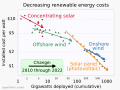 Decreasing renewable energy costs versus deployment in 2010


Medical Disclaimer: WikiMD is for informational purposes only and is not a substitute for professional medical advice. Content may be inaccurate or outdated and should not be used for diagnosis or treatment. Always consult your healthcare provider for medical decisions. Verify information with trusted sources such as CDC.gov and NIH.gov. By using this site, you agree that WikiMD is not liable for any outcomes related to its content. See full disclaimer.
Credits:Most images are courtesy of Wikimedia commons, and templates, categories Wikipedia, licensed under CC BY SA or similar.
Translate page: - East Asian
中文,
日本,
한국어,
South Asian
हिन्दी,
தமிழ்,
తెలుగు,
Urdu,
ಕನ್ನಡ,
Southeast Asian
Indonesian,
Vietnamese,
Thai,
မြန်မာဘာသာ,
বাংলা
European
español,
Deutsch,
français,
Greek,
português do Brasil,
polski,
română,
русский,
Nederlands,
norsk,
svenska,
suomi,
Italian
Middle Eastern & African
عربى,
Turkish,
Persian,
Hebrew,
Afrikaans,
isiZulu,
Kiswahili,
Other
Bulgarian,
Hungarian,
Czech,
Swedish,
മലയാളം,
मराठी,
ਪੰਜਾਬੀ,
ગુજરાતી,
Portuguese,
Ukrainian


