Phylogenetic tree
Phylogenetic tree is a diagram or a tree-like structure that represents the evolutionary relationships among various biological species or other entities that are believed to have a common ancestor. Each branch in the tree signifies a potential divergence from the ancestral line, and each node represents a hypothetical ancestor. The tip of each branch represents the descendants that are living today.
Overview[edit]
The concept of a phylogenetic tree has its roots in the work of Charles Darwin, who first introduced the idea in his book On the Origin of Species. The modern version of the phylogenetic tree, however, has been developed through the application of molecular biology, genetics, and bioinformatics.
Construction[edit]
The construction of a phylogenetic tree involves several steps. First, the genetic sequence data of the species under study is collected. This data is then analyzed using various statistical methods to determine the most likely tree structure. The final tree is then drawn based on this analysis.
Types[edit]
There are several types of phylogenetic trees, including cladograms, phenograms, and phylograms. Each type represents the evolutionary relationships in a slightly different way.
Uses[edit]
Phylogenetic trees are used in many areas of biology, including taxonomy, evolutionary biology, and ecology. They are also used in the study of viruses and bacteria, as well as in the development of new drugs and vaccines.
See also[edit]
References[edit]

This WikiMD article can only be edited by registered and verified editors. You can log in or register.
-
Phylogenetic tree in Braille
-
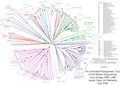 Unrooted tree of myosin
 -
Number of trees as a function of the number of leaves
-
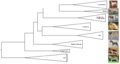 Phylogenetic tree of dogs
 -
Phylogenetic chart of Lepidoptera chronogram
-
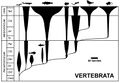 Spindle diagram
 -
The Coral of Life prototype


Sponsored Health Resource

W8MD Weight Loss, Sleep & MedSpa
Looking for physician-supervised weight loss, semaglutide, tirzepatide, or GLP-1 receptor agonist options? W8MD helps eligible patients in New York City, Brooklyn, New Jersey, Connecticut, Pennsylvania, Delaware, and greater Philadelphia with medical weight loss, sleep medicine, and long-term maintenance support.
GLP-1 specials: Affordable GLP-1 injections NYC and Philadelphia starting from $29.99/week and up for semaglutide with insurance accepted for qualifying visits, and $45/week and up for tirzepatide with insurance accepted for qualifying visits. Self-pay options start from $59.99/week and up for semaglutide and $69.99/week and up for tirzepatide.
- Medical weight loss NYC
- Affordable GLP-1 injections NYC
- Budget GLP-1 weight loss shots Philadelphia
- New Jersey medical weight loss
- NYC medical weight loss blog
- Philadelphia weight loss blog
- Sleep medicine and sleep apnea services
- W8MD MedSpa and wellness
Book a W8MD appointment · View GLP-1 specials
Paid promotional message. Eligibility, pricing, insurance coverage, medication availability, and results vary. Medical evaluation required.

Medical Disclaimer: WikiMD is for informational purposes only and is not a substitute for professional medical advice. Content may be inaccurate or outdated and should not be used for diagnosis or treatment. Always consult your healthcare provider for medical decisions. Verify information with trusted sources such as CDC.gov and NIH.gov. By using this site, you agree that WikiMD is not liable for any outcomes related to its content. See full disclaimer.
Credits:Most images are courtesy of Wikimedia commons, and templates, categories Wikipedia, licensed under CC BY SA or similar.
Translate page: - East Asian
中文,
日本,
한국어,
South Asian
हिन्दी,
தமிழ்,
తెలుగు,
Urdu,
ಕನ್ನಡ,
Southeast Asian
Indonesian,
Vietnamese,
Thai,
မြန်မာဘာသာ,
বাংলা
European
español,
Deutsch,
français,
Greek,
português do Brasil,
polski,
română,
русский,
Nederlands,
norsk,
svenska,
suomi,
Italian
Middle Eastern & African
عربى,
Turkish,
Persian,
Hebrew,
Afrikaans,
isiZulu,
Kiswahili,
Other
Bulgarian,
Hungarian,
Czech,
Swedish,
മലയാളം,
मराठी,
ਪੰਜਾਬੀ,
ગુજરાતી,
Portuguese,
Ukrainian


