Time
Time is the never-ending continued progress of existence and events. It happens in an apparently irreversable way from the past, through the present to the future.
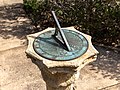
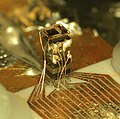
To measure time, we can use anything that repeats itself regularly. One example is the start of a new day (as Earth rotates on its axis). Two more are the phases of the moon (as it orbits the Earth), and the seasons of the year (as the Earth orbits the Sun). Even in ancient times, people developed calendars to keep track of the number of days in a year. They also developed sundials that used the moving shadows cast by the sun through the day to measure times smaller than a day. Today, highly accurate clocks can measure times less than a billionth of a second. The study of time measurement is horology.
The SI (International Systems of Units) unit of time is one second, written as s.
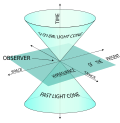
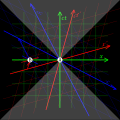
In Einsteinian physics, time and space can be combined into a single concept. See space-time continuum.
Units of time[edit]
- 1 millennium = 10 centuries = 100 decades = 200 lustrums = 250 quadrenniums = 333.33 trienniums = 500 bienniums = 1,000 years
- 1 century = 10 decades = 20 lustrums = 25 quadrenniums = 33.33 trienniums = 50 bienniums = 100 years
- 1 decade = 2 lustrums = 2.5 quadrenniums = 3.33 trienniums = 5 bienniums = 10 years
- 1 year = 12 months = 365 days (366 days in leap years)
- 1 month = 4 weeks = 28 to 31 days
- 1 fortnight = 2 weeks = 14 days
- 1 week = 7 days
- 1 day = 24 hours
- 1 hour = 60 minutes
- 1 minute = 60 seconds
- 1 second = SI base unit of time
- 1 millisecond = 1/1,000 second
- 1 microsecond = 1/1,000,000 second
- 1 nanosecond = 1/1,000,000,000 second
- 1 picosecond = 1/1,000,000,000,000 of a second
- 1 femtosecond = 1/1,000,000,000,000,000 of a second
- 1 attosecond = 1/1,000,000,000,000,000,000 of a second
- 1 Planck time = smallest measurable unit of time
Things to measure time[edit]
Time of day[edit]
- World Clock
- U.S. Naval Observatory
- Time in Hexadecimal numeral system
-
 Time
Time -
 Time
Time -
 Time
Time -
 Time
Time -
 Time
Time -
 Time
Time -
 Time
Time -
 Time
Time -
 Time
Time -
 Time
Time -
 Time
Time

,_Albert_Hall,_Sundial_--_2019_--_1740.jpg)


Sponsored Health Resource

W8MD Weight Loss, Sleep & MedSpa
Looking for physician-supervised weight loss, semaglutide, tirzepatide, or GLP-1 receptor agonist options? W8MD helps eligible patients in New York City, Brooklyn, New Jersey, Connecticut, Pennsylvania, Delaware, and greater Philadelphia with medical weight loss, sleep medicine, and long-term maintenance support.
GLP-1 specials: Affordable GLP-1 injections NYC and Philadelphia starting from $29.99/week and up for semaglutide with insurance accepted for qualifying visits, and $45/week and up for tirzepatide with insurance accepted for qualifying visits. Self-pay options start from $59.99/week and up for semaglutide and $69.99/week and up for tirzepatide.
- Medical weight loss NYC
- Affordable GLP-1 injections NYC
- Budget GLP-1 weight loss shots Philadelphia
- New Jersey medical weight loss
- NYC medical weight loss blog
- Philadelphia weight loss blog
- Sleep medicine and sleep apnea services
- W8MD MedSpa and wellness
Book a W8MD appointment · View GLP-1 specials
Paid promotional message. Eligibility, pricing, insurance coverage, medication availability, and results vary. Medical evaluation required.

Medical Disclaimer: WikiMD is for informational purposes only and is not a substitute for professional medical advice. Content may be inaccurate or outdated and should not be used for diagnosis or treatment. Always consult your healthcare provider for medical decisions. Verify information with trusted sources such as CDC.gov and NIH.gov. By using this site, you agree that WikiMD is not liable for any outcomes related to its content. See full disclaimer.
Credits:Most images are courtesy of Wikimedia commons, and templates, categories Wikipedia, licensed under CC BY SA or similar.
Translate page: - East Asian
中文,
日本,
한국어,
South Asian
हिन्दी,
தமிழ்,
తెలుగు,
Urdu,
ಕನ್ನಡ,
Southeast Asian
Indonesian,
Vietnamese,
Thai,
မြန်မာဘာသာ,
বাংলা
European
español,
Deutsch,
français,
Greek,
português do Brasil,
polski,
română,
русский,
Nederlands,
norsk,
svenska,
suomi,
Italian
Middle Eastern & African
عربى,
Turkish,
Persian,
Hebrew,
Afrikaans,
isiZulu,
Kiswahili,
Other
Bulgarian,
Hungarian,
Czech,
Swedish,
മലയാളം,
मराठी,
ਪੰਜਾਬੀ,
ગુજરાતી,
Portuguese,
Ukrainian

