Gluteus maximus
Gluteus maximus is the largest and most superficial of the three gluteal muscles. It makes up a large portion of the shape and appearance of the buttocks. Its thick fleshy mass, in a quadrilateral shape, forms the prominence of the buttocks. Its large size is one of the most characteristic features of the muscular system in humans, connected as it is with the power of maintaining the trunk in the erect posture. Other primates have a much less developed gluteus maximus.
Anatomy[edit]
The gluteus maximus arises from the posterior gluteal line of the inner upper ilium, and the rough portion of bone including the crest, immediately above and behind it; from the posterior surface of the lower part of the sacrum and the side of the coccyx; from the aponeurosis of the erector spinae (lumbodorsal fascia), the sacrotuberous ligament, and the fascia covering the gluteus medius.
Function[edit]
The gluteus maximus is involved in a number of actions, including extension and external rotation of the hip joint, and adduction and abduction of the hip (outward and inward movement). It is also one of the chief muscles for hip extension when the thigh is flexed at the hip, such as in climbing stairs or rising from a sitting position.
Clinical significance[edit]
Injury or strain to the gluteus maximus can cause pain and difficulty with movement. It can also be involved in conditions such as piriformis syndrome, in which the piriformis muscle irritates the sciatic nerve, causing pain in the buttocks and referring pain along the course of the sciatic nerve.
See also[edit]
References[edit]

This WikiMD article can only be edited by registered and verified editors. You can log in or register.
-
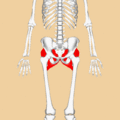 Gluteus maximus
 -
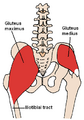 Gluteus maximus
 -
 Gluteus maximus
 -
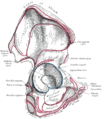 Gluteus maximus
 -
 Gluteus maximus
 -
 Gluteus maximus
 -
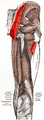 Gluteus maximus
 -
 Gluteus maximus
 -
 Gluteus maximus
 -
 Gluteus maximus
 -
 Gluteus maximus
 -
 Gluteus maximus


_-_Fig._349.png)

_-_Vol_1_-_Fig_339.png)
_-_Vol_1_-_Fig_176-177.png)


Sponsored Health Resource

W8MD Weight Loss, Sleep & MedSpa
Looking for physician-supervised weight loss, semaglutide, tirzepatide, or GLP-1 receptor agonist options? W8MD helps eligible patients in New York City, Brooklyn, New Jersey, Connecticut, Pennsylvania, Delaware, and greater Philadelphia with medical weight loss, sleep medicine, and long-term maintenance support.
GLP-1 specials: Affordable GLP-1 injections NYC and Philadelphia starting from $29.99/week and up for semaglutide with insurance accepted for qualifying visits, and $45/week and up for tirzepatide with insurance accepted for qualifying visits. Self-pay options start from $59.99/week and up for semaglutide and $69.99/week and up for tirzepatide.
- Medical weight loss NYC
- Affordable GLP-1 injections NYC
- Budget GLP-1 weight loss shots Philadelphia
- New Jersey medical weight loss
- NYC medical weight loss blog
- Philadelphia weight loss blog
- Sleep medicine and sleep apnea services
- W8MD MedSpa and wellness
Book a W8MD appointment · View GLP-1 specials
Paid promotional message. Eligibility, pricing, insurance coverage, medication availability, and results vary. Medical evaluation required.

Medical Disclaimer: WikiMD is for informational purposes only and is not a substitute for professional medical advice. Content may be inaccurate or outdated and should not be used for diagnosis or treatment. Always consult your healthcare provider for medical decisions. Verify information with trusted sources such as CDC.gov and NIH.gov. By using this site, you agree that WikiMD is not liable for any outcomes related to its content. See full disclaimer.
Credits:Most images are courtesy of Wikimedia commons, and templates, categories Wikipedia, licensed under CC BY SA or similar.
Translate page: - East Asian
中文,
日本,
한국어,
South Asian
हिन्दी,
தமிழ்,
తెలుగు,
Urdu,
ಕನ್ನಡ,
Southeast Asian
Indonesian,
Vietnamese,
Thai,
မြန်မာဘာသာ,
বাংলা
European
español,
Deutsch,
français,
Greek,
português do Brasil,
polski,
română,
русский,
Nederlands,
norsk,
svenska,
suomi,
Italian
Middle Eastern & African
عربى,
Turkish,
Persian,
Hebrew,
Afrikaans,
isiZulu,
Kiswahili,
Other
Bulgarian,
Hungarian,
Czech,
Swedish,
മലയാളം,
मराठी,
ਪੰਜਾਬੀ,
ગુજરાતી,
Portuguese,
Ukrainian

