Methanogenesis
Methanogenesis is a unique form of respiration that occurs in microorganisms known as methanogens. This process involves the production of methane from a variety of substrates, including carbon dioxide, formate, acetate, and methylamines. Methanogenesis is a critical step in the carbon cycle, as it allows for the recycling of carbon in anaerobic environments.
Overview[edit]
Methanogenesis is a form of anaerobic respiration that is carried out by a group of microorganisms known as methanogens. These organisms are part of the domain Archaea, and they are found in a variety of anaerobic environments, including wetlands, ruminant digestive systems, and sediments. Methanogenesis is a critical step in the carbon cycle, as it allows for the recycling of carbon in environments where oxygen is not present.
Process[edit]
Methanogenesis involves the reduction of carbon dioxide, formate, acetate, or methylamines to methane. This process is carried out by a series of enzymes, and it is coupled to the generation of adenosine triphosphate (ATP) for energy. The overall reaction for methanogenesis from carbon dioxide is:
CO2 + 4H2 → CH4 + 2H2O
This reaction is exothermic, meaning it releases energy that the methanogens can use for growth and reproduction.
Ecological significance[edit]
Methanogenesis is a critical step in the carbon cycle, as it allows for the recycling of carbon in anaerobic environments. Methane produced by methanogenesis is a potent greenhouse gas, and it contributes significantly to global warming. However, methanogenesis also plays a critical role in the removal of excess carbon dioxide from the atmosphere, as it converts this greenhouse gas into a less potent form.
See also[edit]

This WikiMD article can only be edited by registered and verified editors. You can log in or register.
Methanogenesis gallery[edit]
-
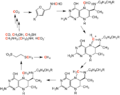 Methanogenesis cycle
 -
Testing Sheep for Methane Production


Medical Disclaimer: WikiMD is for informational purposes only and is not a substitute for professional medical advice. Content may be inaccurate or outdated and should not be used for diagnosis or treatment. Always consult your healthcare provider for medical decisions. Verify information with trusted sources such as CDC.gov and NIH.gov. By using this site, you agree that WikiMD is not liable for any outcomes related to its content. See full disclaimer.
Credits:Most images are courtesy of Wikimedia commons, and templates, categories Wikipedia, licensed under CC BY SA or similar.
Translate page: - East Asian
中文,
日本,
한국어,
South Asian
हिन्दी,
தமிழ்,
తెలుగు,
Urdu,
ಕನ್ನಡ,
Southeast Asian
Indonesian,
Vietnamese,
Thai,
မြန်မာဘာသာ,
বাংলা
European
español,
Deutsch,
français,
Greek,
português do Brasil,
polski,
română,
русский,
Nederlands,
norsk,
svenska,
suomi,
Italian
Middle Eastern & African
عربى,
Turkish,
Persian,
Hebrew,
Afrikaans,
isiZulu,
Kiswahili,
Other
Bulgarian,
Hungarian,
Czech,
Swedish,
മലയാളം,
मराठी,
ਪੰਜਾਬੀ,
ગુજરાતી,
Portuguese,
Ukrainian


