Pa amb tomàquet
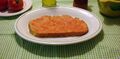
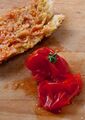
Pa amb tomàquet (also known as pan con tomate in Spanish) is a traditional Catalan dish. It is a simple yet flavorful dish that is often served as a tapa in Spain. The dish is made by rubbing ripe tomatoes and garlic on toasted bread, then drizzling it with olive oil and a pinch of salt.
History[edit]
The origins of Pa amb tomàquet are not clear, but it is believed to have been a staple in the Catalan diet since the 18th century. The dish was likely created as a way to use up stale bread and overripe tomatoes. It has since become a symbol of Catalan identity and is a common feature in Catalan cuisine.
Preparation[edit]
The preparation of Pa amb tomàquet is simple and straightforward. A piece of bread, usually a rustic country loaf, is toasted until it is crispy. A ripe tomato is then cut in half and rubbed over the bread, followed by a clove of garlic. The bread is then drizzled with olive oil and sprinkled with salt. Some variations of the dish also include toppings like Iberian ham, Manchego, or anchovies.
Cultural Significance[edit]
Pa amb tomàquet is more than just a dish in Catalonia. It is a symbol of Catalan identity and a staple at any meal, from breakfast to dinner. It is also a common accompaniment to tapas and is often served with local wines. The dish is so popular that it even has its own festival, the Festa del Pa amb Tomàquet, held annually in the town of Monells.
See Also[edit]
| Catalan cuisine | ||||||||||
|---|---|---|---|---|---|---|---|---|---|---|
This Catalan cuisine-related article is a stub.
|
| Spanish cuisine | ||||||||||
|---|---|---|---|---|---|---|---|---|---|---|
This Spanish cuisine related article is a stub.
|

-
 Pa amb tomàquet
 -
 Pa amb tomàquet
 -
 Pa amb tomàquet
 -
 Pa amb tomàquet
 -
 Pa amb tomàquet
 -
 Pa amb tomàquet
 -
 Pa amb tomàquet
 -
 Pa amb tomàquet
 -
 Pa amb tomàquet
 -
 Pa amb tomàquet
 -
 Pa amb tomàquet


.jpg)


Sponsored Health Resource

W8MD Weight Loss, Sleep & MedSpa
Looking for physician-supervised weight loss, semaglutide, tirzepatide, or GLP-1 receptor agonist options? W8MD helps eligible patients in New York City, Brooklyn, New Jersey, Connecticut, Pennsylvania, Delaware, and greater Philadelphia with medical weight loss, sleep medicine, and long-term maintenance support.
GLP-1 specials: Affordable GLP-1 injections NYC and Philadelphia starting from $29.99/week and up for semaglutide with insurance accepted for qualifying visits, and $45/week and up for tirzepatide with insurance accepted for qualifying visits. Self-pay options start from $59.99/week and up for semaglutide and $69.99/week and up for tirzepatide.
- Medical weight loss NYC
- Affordable GLP-1 injections NYC
- Budget GLP-1 weight loss shots Philadelphia
- New Jersey medical weight loss
- NYC medical weight loss blog
- Philadelphia weight loss blog
- Sleep medicine and sleep apnea services
- W8MD MedSpa and wellness
Book a W8MD appointment · View GLP-1 specials
Paid promotional message. Eligibility, pricing, insurance coverage, medication availability, and results vary. Medical evaluation required.

Medical Disclaimer: WikiMD is for informational purposes only and is not a substitute for professional medical advice. Content may be inaccurate or outdated and should not be used for diagnosis or treatment. Always consult your healthcare provider for medical decisions. Verify information with trusted sources such as CDC.gov and NIH.gov. By using this site, you agree that WikiMD is not liable for any outcomes related to its content. See full disclaimer.
Credits:Most images are courtesy of Wikimedia commons, and templates, categories Wikipedia, licensed under CC BY SA or similar.
Translate page: - East Asian
中文,
日本,
한국어,
South Asian
हिन्दी,
தமிழ்,
తెలుగు,
Urdu,
ಕನ್ನಡ,
Southeast Asian
Indonesian,
Vietnamese,
Thai,
မြန်မာဘာသာ,
বাংলা
European
español,
Deutsch,
français,
Greek,
português do Brasil,
polski,
română,
русский,
Nederlands,
norsk,
svenska,
suomi,
Italian
Middle Eastern & African
عربى,
Turkish,
Persian,
Hebrew,
Afrikaans,
isiZulu,
Kiswahili,
Other
Bulgarian,
Hungarian,
Czech,
Swedish,
മലയാളം,
मराठी,
ਪੰਜਾਬੀ,
ગુજરાતી,
Portuguese,
Ukrainian

