Uruguay
History[edit]

.jpg)


Uruguay, officially known as the República Oriental del Uruguay, is a country in the southeastern region of South America. It is bordered by Brazil to the north, the Atlantic Ocean to the southeast, and the Río de la Plata to the south. The country has a rich history that dates back to the pre-Columbian era when it was inhabited by the Charrúa people.
The first European to explore Uruguay was the Spanish explorer Juan Díaz de Solís in 1516. However, it was the Portuguese who established the first European settlement in the region at Colonia del Sacramento in 1680. The Spanish later founded Montevideo in 1726 as a strategic move to counter Portuguese expansion.
During the early 19th century, Uruguay was caught in the struggle for independence from Spain, which was part of the larger Latin American wars of independence. The country declared its independence on August 25, 1825, after a series of conflicts known as the Cisplatine War
The 19th Century[edit]
The 19th century was marked by political instability and civil wars, including the Guerra Grande (1839-1851), a civil war between the Blancos and Colorados, the two main political parties. The Battle of Caseros in 1852 was a significant event that led to the end of the Juan Manuel de Rosas regime in Argentina, impacting Uruguay's political landscape.
20th Century to Present[edit]
In the 20th century, Uruguay became known for its advanced social legislation and welfare state, earning the nickname "the Switzerland of South America." The country experienced a period of economic prosperity in the early 20th century, but this was followed by economic decline and political turmoil in the 1960s and 1970s, culminating in a military dictatorship from 1973 to 1985.
Since the restoration of democracy in 1985, Uruguay has been a stable democracy with a growing economy. It is known for its progressive policies, including the legalization of same-sex marriage and the regulation of the cannabis market.
Geography[edit]
Uruguay is the second smallest country in South America, with a total area of approximately 176,000 square kilometers. The country is mostly flat, with a few hilly areas in the south. The Rio de la Plata and the Uruguay River are the main water bodies.
The climate is temperate, with warm summers and mild winters. The country is divided into 19 departments, each with its own local government.
Economy[edit]
Uruguay has a mixed economy with a high level of social spending. The country is known for its agricultural products, particularly beef and wool, and has a growing services sector. Montevideo is the economic and financial center of the country.
Uruguay is a member of the Southern Common Market (Mercosur), which has helped boost trade with neighboring countries.
Culture[edit]
Uruguayan culture is a blend of European influences, particularly Spanish and Italian, with indigenous elements. The country is known for its tango music and dance, as well as its candombe and murga performances.
Football is the most popular sport in Uruguay, and the country has a rich football history, having won the FIFA World Cup twice, in 1930 and 1950.
Related pages[edit]
Gallery[edit]
-
 Legislative Palace
 -
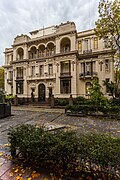 Piria Palace, Montevideo
 -
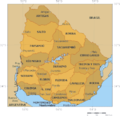 Map of the departments of Uruguay
 -
 Mercosur headquarters
 -
 M41A3 Walker Bulldog
 -
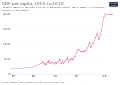 GDP per capita development of Uruguay
 -
 World Trade Center Montevideo
 -
 Punta del Este
 -
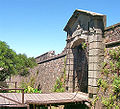 Colonia del Sacramento
 -
 Carrasco International Airport
 -
 Punta del Este Airport
 -
 Church of San Carlos
 -
 Faculty of Medicine, Montevideo
 -
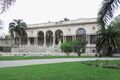 Italian Hospital in Montevideo
 -
 Casapueblo
 -
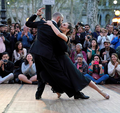 Tango dancers in Montevideo
 -
 Murga performance
 -
 Estadio Centenario


.png)


.jpg)


.jpg)


Medical Disclaimer: WikiMD is for informational purposes only and is not a substitute for professional medical advice. Content may be inaccurate or outdated and should not be used for diagnosis or treatment. Always consult your healthcare provider for medical decisions. Verify information with trusted sources such as CDC.gov and NIH.gov. By using this site, you agree that WikiMD is not liable for any outcomes related to its content. See full disclaimer.
Credits:Most images are courtesy of Wikimedia commons, and templates, categories Wikipedia, licensed under CC BY SA or similar.
Translate page: - East Asian
中文,
日本,
한국어,
South Asian
हिन्दी,
தமிழ்,
తెలుగు,
Urdu,
ಕನ್ನಡ,
Southeast Asian
Indonesian,
Vietnamese,
Thai,
မြန်မာဘာသာ,
বাংলা
European
español,
Deutsch,
français,
Greek,
português do Brasil,
polski,
română,
русский,
Nederlands,
norsk,
svenska,
suomi,
Italian
Middle Eastern & African
عربى,
Turkish,
Persian,
Hebrew,
Afrikaans,
isiZulu,
Kiswahili,
Other
Bulgarian,
Hungarian,
Czech,
Swedish,
മലയാളം,
मराठी,
ਪੰਜਾਬੀ,
ગુજરાતી,
Portuguese,
Ukrainian

