Motor protein
Motor proteins are a class of molecular motors that can move along the surface of a suitable substrate. They are powered by the hydrolysis of adenosine triphosphate (ATP) and convert chemical energy into mechanical work.
Types of Motor Proteins[edit]
There are three types of motor proteins:
- Myosin, which moves along actin filaments
- Kinesin, which moves along microtubules
- Dynein, which also moves along microtubules
Each of these proteins has a distinct function in the cell, and they are all essential for various types of cell movement.
Function of Motor Proteins[edit]
Motor proteins are responsible for a wide range of cellular processes. They are involved in cell division, intracellular transport, and muscle contraction. They also play a role in the movement of organelles and vesicles within cells, the beating of cilia and flagella, and the movement of chromosomes during mitosis and meiosis.
Structure of Motor Proteins[edit]
Motor proteins have a common basic structure. They consist of one or more heavy chains, which provide the force for movement, and several light chains, which regulate the activity of the heavy chains. The heavy chains have a globular head, which binds to the substrate and hydrolyzes ATP, and a tail, which interacts with the cargo that the motor protein is moving.
Mechanism of Action[edit]
The movement of motor proteins is powered by the hydrolysis of ATP. The energy released by this reaction is used to change the shape of the motor protein, which allows it to move along the substrate. The exact mechanism of movement varies between different types of motor proteins, but it generally involves a cycle of binding to the substrate, hydrolyzing ATP, releasing the products of hydrolysis, and detaching from the substrate.
Role in Disease[edit]
Defects in motor proteins can lead to a variety of diseases. For example, mutations in the genes for dynein can cause neurodegenerative diseases such as amyotrophic lateral sclerosis (ALS). Mutations in the genes for kinesin can cause neuropathies, and mutations in the genes for myosin can cause myopathies.
See Also[edit]

This WikiMD article can only be edited by registered and verified editors. You can log in or register.
Motor protein[edit]
-
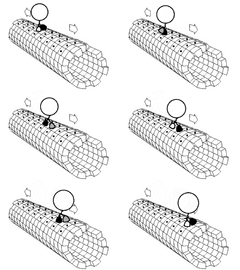 Kinesin walking
 -
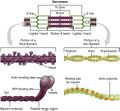 Thick and Thin Filaments


Sponsored Health Resource

W8MD Weight Loss, Sleep & MedSpa
Looking for physician-supervised weight loss, semaglutide, tirzepatide, or GLP-1 receptor agonist options? W8MD helps eligible patients in New York City, Brooklyn, New Jersey, Connecticut, Pennsylvania, Delaware, and greater Philadelphia with medical weight loss, sleep medicine, and long-term maintenance support.
GLP-1 specials: Affordable GLP-1 injections NYC and Philadelphia starting from $29.99/week and up for semaglutide with insurance accepted for qualifying visits, and $45/week and up for tirzepatide with insurance accepted for qualifying visits. Self-pay options start from $59.99/week and up for semaglutide and $69.99/week and up for tirzepatide.
- Medical weight loss NYC
- Affordable GLP-1 injections NYC
- Budget GLP-1 weight loss shots Philadelphia
- New Jersey medical weight loss
- NYC medical weight loss blog
- Philadelphia weight loss blog
- Sleep medicine and sleep apnea services
- W8MD MedSpa and wellness
Book a W8MD appointment · View GLP-1 specials
Paid promotional message. Eligibility, pricing, insurance coverage, medication availability, and results vary. Medical evaluation required.

Medical Disclaimer: WikiMD is for informational purposes only and is not a substitute for professional medical advice. Content may be inaccurate or outdated and should not be used for diagnosis or treatment. Always consult your healthcare provider for medical decisions. Verify information with trusted sources such as CDC.gov and NIH.gov. By using this site, you agree that WikiMD is not liable for any outcomes related to its content. See full disclaimer.
Credits:Most images are courtesy of Wikimedia commons, and templates, categories Wikipedia, licensed under CC BY SA or similar.
Translate page: - East Asian
中文,
日本,
한국어,
South Asian
हिन्दी,
தமிழ்,
తెలుగు,
Urdu,
ಕನ್ನಡ,
Southeast Asian
Indonesian,
Vietnamese,
Thai,
မြန်မာဘာသာ,
বাংলা
European
español,
Deutsch,
français,
Greek,
português do Brasil,
polski,
română,
русский,
Nederlands,
norsk,
svenska,
suomi,
Italian
Middle Eastern & African
عربى,
Turkish,
Persian,
Hebrew,
Afrikaans,
isiZulu,
Kiswahili,
Other
Bulgarian,
Hungarian,
Czech,
Swedish,
മലയാളം,
मराठी,
ਪੰਜਾਬੀ,
ગુજરાતી,
Portuguese,
Ukrainian

