Catechol
Catechol (also known as 1,2-dihydroxybenzene or pyrocatechol) is an organic compound with the molecular formula C6H4(OH)2. It is a type of benzene derivative and is one of the three isomeric benzenediols, the others being resorcinol (1,3-dihydroxybenzene) and hydroquinone (1,4-dihydroxybenzene).
Structure and Properties[edit]
Catechol consists of a benzene ring with two adjacent hydroxyl groups. It is a colorless compound that is soluble in water and exhibits a characteristic phenolic odor. The presence of the hydroxyl groups makes catechol a relatively reactive compound, capable of undergoing various chemical reactions such as oxidation and electrophilic substitution.
Synthesis[edit]
Catechol can be synthesized through several methods, including the hydroxylation of phenol using hydrogen peroxide in the presence of a catalyst. Another common method involves the hydrolysis of o-dichlorobenzene.
Applications[edit]
Catechol is used in a variety of industrial and research applications. It serves as a precursor to various chemicals, including pesticides, pharmaceuticals, and flavoring agents. In the field of biochemistry, catechol is used as a substrate in enzyme assays to study the activity of catechol oxidase and other related enzymes.
Biological Role[edit]
In nature, catechol is found in various plants and is involved in the biosynthesis of lignin, a complex polymer that provides structural support to plant cell walls. It also plays a role in the defense mechanisms of plants against herbivores and pathogens.
Safety and Handling[edit]
Catechol is classified as a hazardous substance and should be handled with care. It can cause skin and eye irritation and may be harmful if ingested or inhaled. Proper safety measures, including the use of personal protective equipment, should be followed when handling catechol.
Related Compounds[edit]
See Also[edit]
References[edit]

Catechol gallery[edit]
-
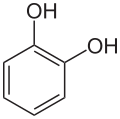 Brenzcatechin
 -
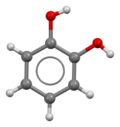 Catechol from crystal orientation 2 3D


Sponsored Health Resource

W8MD Weight Loss, Sleep & MedSpa
Looking for physician-supervised weight loss, semaglutide, tirzepatide, or GLP-1 receptor agonist options? W8MD helps eligible patients in New York City, Brooklyn, New Jersey, Connecticut, Pennsylvania, Delaware, and greater Philadelphia with medical weight loss, sleep medicine, and long-term maintenance support.
GLP-1 specials: Affordable GLP-1 injections NYC and Philadelphia starting from $29.99/week and up for semaglutide with insurance accepted for qualifying visits, and $45/week and up for tirzepatide with insurance accepted for qualifying visits. Self-pay options start from $59.99/week and up for semaglutide and $69.99/week and up for tirzepatide.
- Medical weight loss NYC
- Affordable GLP-1 injections NYC
- Budget GLP-1 weight loss shots Philadelphia
- New Jersey medical weight loss
- NYC medical weight loss blog
- Philadelphia weight loss blog
- Sleep medicine and sleep apnea services
- W8MD MedSpa and wellness
Book a W8MD appointment · View GLP-1 specials
Paid promotional message. Eligibility, pricing, insurance coverage, medication availability, and results vary. Medical evaluation required.

Medical Disclaimer: WikiMD is for informational purposes only and is not a substitute for professional medical advice. Content may be inaccurate or outdated and should not be used for diagnosis or treatment. Always consult your healthcare provider for medical decisions. Verify information with trusted sources such as CDC.gov and NIH.gov. By using this site, you agree that WikiMD is not liable for any outcomes related to its content. See full disclaimer.
Credits:Most images are courtesy of Wikimedia commons, and templates, categories Wikipedia, licensed under CC BY SA or similar.
Translate page: - East Asian
中文,
日本,
한국어,
South Asian
हिन्दी,
தமிழ்,
తెలుగు,
Urdu,
ಕನ್ನಡ,
Southeast Asian
Indonesian,
Vietnamese,
Thai,
မြန်မာဘာသာ,
বাংলা
European
español,
Deutsch,
français,
Greek,
português do Brasil,
polski,
română,
русский,
Nederlands,
norsk,
svenska,
suomi,
Italian
Middle Eastern & African
عربى,
Turkish,
Persian,
Hebrew,
Afrikaans,
isiZulu,
Kiswahili,
Other
Bulgarian,
Hungarian,
Czech,
Swedish,
മലയാളം,
मराठी,
ਪੰਜਾਬੀ,
ગુજરાતી,
Portuguese,
Ukrainian

