Ross procedure
The Ross Procedure is a type of cardiac surgery that involves the replacement of a patient's diseased aortic valve with their own pulmonary valve. This procedure was first performed by Donald Ross in 1967 and has since been used as a treatment option for various heart valve diseases.
History[edit]
The Ross Procedure was first performed by British surgeon Donald Ross in 1967. Ross was a pioneer in the field of cardiac surgery, and his innovative procedure offered a new treatment option for patients with aortic valve disease.
Procedure[edit]
The Ross Procedure involves the removal of the patient's diseased aortic valve. The surgeon then removes the patient's healthy pulmonary valve and transplants it into the position of the aortic valve. A homograft (valve from a donor) is then used to replace the patient's pulmonary valve.
The advantage of this procedure is that the transplanted pulmonary valve can grow with the patient, making it an ideal option for children or young adults who need aortic valve replacement. Furthermore, because the replacement valve is the patient's own tissue, there is no need for lifelong anticoagulation therapy.
Risks and Complications[edit]
Like all surgeries, the Ross Procedure carries some risks. These include the standard risks associated with any major surgery, such as infection, bleeding, and reactions to anesthesia. Specific to the Ross Procedure, there is a risk of failure of the transplanted pulmonary valve, which may require further surgery.
See Also[edit]
References[edit]
| Tests and procedures involving the heart | ||||||||||
|---|---|---|---|---|---|---|---|---|---|---|
|
 | This medical article is a stub. You can help WikiMD by expanding the page. |
-
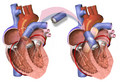 Ross procedure
 -
 Diagram of the human heart

.svg)
Sponsored Health Resource

W8MD Weight Loss, Sleep & MedSpa
Looking for physician-supervised weight loss, semaglutide, tirzepatide, or GLP-1 receptor agonist options? W8MD helps eligible patients in New York City, Brooklyn, New Jersey, Connecticut, Pennsylvania, Delaware, and greater Philadelphia with medical weight loss, sleep medicine, and long-term maintenance support.
GLP-1 specials: Affordable GLP-1 injections NYC and Philadelphia starting from $29.99/week and up for semaglutide with insurance accepted for qualifying visits, and $45/week and up for tirzepatide with insurance accepted for qualifying visits. Self-pay options start from $59.99/week and up for semaglutide and $69.99/week and up for tirzepatide.
- Medical weight loss NYC
- Affordable GLP-1 injections NYC
- Budget GLP-1 weight loss shots Philadelphia
- New Jersey medical weight loss
- NYC medical weight loss blog
- Philadelphia weight loss blog
- Sleep medicine and sleep apnea services
- W8MD MedSpa and wellness
Book a W8MD appointment · View GLP-1 specials
Paid promotional message. Eligibility, pricing, insurance coverage, medication availability, and results vary. Medical evaluation required.

Medical Disclaimer: WikiMD is for informational purposes only and is not a substitute for professional medical advice. Content may be inaccurate or outdated and should not be used for diagnosis or treatment. Always consult your healthcare provider for medical decisions. Verify information with trusted sources such as CDC.gov and NIH.gov. By using this site, you agree that WikiMD is not liable for any outcomes related to its content. See full disclaimer.
Credits:Most images are courtesy of Wikimedia commons, and templates, categories Wikipedia, licensed under CC BY SA or similar.
Translate page: - East Asian
中文,
日本,
한국어,
South Asian
हिन्दी,
தமிழ்,
తెలుగు,
Urdu,
ಕನ್ನಡ,
Southeast Asian
Indonesian,
Vietnamese,
Thai,
မြန်မာဘာသာ,
বাংলা
European
español,
Deutsch,
français,
Greek,
português do Brasil,
polski,
română,
русский,
Nederlands,
norsk,
svenska,
suomi,
Italian
Middle Eastern & African
عربى,
Turkish,
Persian,
Hebrew,
Afrikaans,
isiZulu,
Kiswahili,
Other
Bulgarian,
Hungarian,
Czech,
Swedish,
മലയാളം,
मराठी,
ਪੰਜਾਬੀ,
ગુજરાતી,
Portuguese,
Ukrainian

