Eyelid

Eyelid[edit]
The eyelid is a delicate, multi-layered fold of skin designed to shield and safeguard the eye. A crucial component of the visual system, the eyelid, apart from the prepuce and the labia minora, boasts some of the thinnest skin in the human body. This article elaborates on its structure, function, and relevance to overall ocular health.

Function[edit]
The core functions of the eyelid include:
- Regularly distributing tears and other secretions across the eye's surface, ensuring the cornea remains constantly moistened.
- Preventing the eyes from drying while asleep.
- Protecting the eye from dust, external particles, and moisture, primarily through the blink reflex.
- Serving as a defense mechanism against potential foreign bodies.
Notably, the human eyelid is adorned with a line of eyelashes, which bolster its protective capacities, especially against foreign particles and sweat.
Anatomy[edit]
File:Slide2www.JPG|Extrinsic eye muscle. Nerves of orbita. Deep dissection]]
Layers[edit]
From the outermost to the innermost layer, the eyelid comprises:
- Skin: Comparable to skin elsewhere on the body but is notably thin and has a higher concentration of pigment cells. In certain conditions, these cells may migrate, causing discoloration.
- Subcutaneous tissue
- Orbicularis oculi: A muscle responsible for eyelid movement.
- Orbital septum and tarsal plates: Provide structural support.
- Palpebral conjunctiva: A mucous membrane that lines the inner surface of the eyelid.
Within the eyelid, the meibomian glands secrete the lipid component of the tear film, essential for eye lubrication.
Innervation[edit]
Sensory innervation for the eyelids is as follows:
- Upper eyelids: Supplied by the infratrochlear, supratrochlear, supraorbital, and lacrimal nerves from the ophthalmic branch (V1) of the trigeminal nerve (CN V).
- Lower eyelids: Primarily supplied by branches of the infraorbital nerve from the maxillary branch (V2) of the trigeminal nerve, with the infratrochlear nerve serving the medial angle.
Blood Supply[edit]
Blood is delivered to the eyelids through two arterial arches in both the upper and lower lids. These arches are formed via anastomoses between the lateral and medial palpebral arteries, derivatives of the lacrimal and ophthalmic arteries respectively.
Etymology[edit]
"Palpebral" and "blepharal" are terms pertaining to the eyelids. Their origins and usage help in the anatomical and clinical description of conditions and procedures linked with the eyelid.
See also[edit]
- Eye anatomy
- Blink reflex
- Ocular system
- Blepharospasm
- Cellulitis
- Chalazion
- Dermatochalasis
- Ectropion
- Entropion
- Hay-Wells syndrome
- Nictitating membrane
- Ptosis
- Stye (Hordeolum)
Additional images[edit]
-
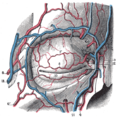 Bloodvessels of the eyelids, front view
 -
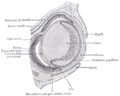 Horizontal section through the eye of an eighteen days' embryo rabbit. X 30
 -
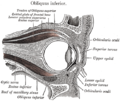 Sagittal section of right orbital cavity
 -
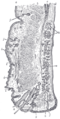 Sagittal section through the upper eyelid
 -
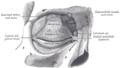 The tarsi and their ligaments. Right eye; front view
 -
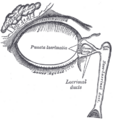 The lacrimal apparatus. Right side


| Anatomy of the globe of the human eye | ||||||||||||||||||
|---|---|---|---|---|---|---|---|---|---|---|---|---|---|---|---|---|---|---|
|

This WikiMD article can only be edited by registered and verified editors. You can log in or register.
| The orbit of the eye | ||||||||||
|---|---|---|---|---|---|---|---|---|---|---|
|
| Anatomy and morphology | ||||||||||
|---|---|---|---|---|---|---|---|---|---|---|
|
Sponsored Health Resource

W8MD Weight Loss, Sleep & MedSpa
Looking for physician-supervised weight loss, semaglutide, tirzepatide, or GLP-1 receptor agonist options? W8MD helps eligible patients in New York City, Brooklyn, New Jersey, Connecticut, Pennsylvania, Delaware, and greater Philadelphia with medical weight loss, sleep medicine, and long-term maintenance support.
GLP-1 specials: Affordable GLP-1 injections NYC and Philadelphia starting from $29.99/week and up for semaglutide with insurance accepted for qualifying visits, and $45/week and up for tirzepatide with insurance accepted for qualifying visits. Self-pay options start from $59.99/week and up for semaglutide and $69.99/week and up for tirzepatide.
- Medical weight loss NYC
- Affordable GLP-1 injections NYC
- Budget GLP-1 weight loss shots Philadelphia
- New Jersey medical weight loss
- NYC medical weight loss blog
- Philadelphia weight loss blog
- Sleep medicine and sleep apnea services
- W8MD MedSpa and wellness
Book a W8MD appointment · View GLP-1 specials
Paid promotional message. Eligibility, pricing, insurance coverage, medication availability, and results vary. Medical evaluation required.

Medical Disclaimer: WikiMD is for informational purposes only and is not a substitute for professional medical advice. Content may be inaccurate or outdated and should not be used for diagnosis or treatment. Always consult your healthcare provider for medical decisions. Verify information with trusted sources such as CDC.gov and NIH.gov. By using this site, you agree that WikiMD is not liable for any outcomes related to its content. See full disclaimer.
Credits:Most images are courtesy of Wikimedia commons, and templates, categories Wikipedia, licensed under CC BY SA or similar.
Translate page: - East Asian
中文,
日本,
한국어,
South Asian
हिन्दी,
தமிழ்,
తెలుగు,
Urdu,
ಕನ್ನಡ,
Southeast Asian
Indonesian,
Vietnamese,
Thai,
မြန်မာဘာသာ,
বাংলা
European
español,
Deutsch,
français,
Greek,
português do Brasil,
polski,
română,
русский,
Nederlands,
norsk,
svenska,
suomi,
Italian
Middle Eastern & African
عربى,
Turkish,
Persian,
Hebrew,
Afrikaans,
isiZulu,
Kiswahili,
Other
Bulgarian,
Hungarian,
Czech,
Swedish,
മലയാളം,
मराठी,
ਪੰਜਾਬੀ,
ગુજરાતી,
Portuguese,
Ukrainian

