Parathyroid gland
The parathyroid glands are small endocrine glands in the neck of humans and other tetrapods that produce parathyroid hormone. Humans usually have four parathyroid glands, which are usually located on the rear surface of the thyroid gland, or, in rare cases, within the thyroid gland itself or in the chest. Parathyroid glands control the amount of calcium in the blood and within the bones.
Structure[edit]
The parathyroid glands are two pairs of glands usually positioned behind the left and right lobes of the thyroid. They are small, light-colored lumps that stick out from the surface of the thyroid gland. Each gland is covered by a thin capsule of connective tissue, and they are usually located on the posterior surface of the thyroid gland.
Function[edit]
The sole function of the parathyroid glands is to regulate the calcium level within the body within a very narrow range so that the nervous and muscular systems can function properly.
Clinical significance[edit]
Parathyroid disease is conventionally divided into states where the parathyroid is overactive (hyperparathyroidism), and states where the parathyroid is under- or hypoactive (hypoparathyroidism).
See also[edit]
References[edit]
External links[edit]
- Parathyroid gland at parathyroid.com
- Parathyroid Glands at endocrineweb.com
| Diseases of the endocrine system (E00–E35, 240–259) | ||||||||||||||||||||||||||||||||||||||
|---|---|---|---|---|---|---|---|---|---|---|---|---|---|---|---|---|---|---|---|---|---|---|---|---|---|---|---|---|---|---|---|---|---|---|---|---|---|---|
|

This WikiMD article can only be edited by registered and verified editors. You can log in or register.
-
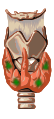 Diagram of the parathyroid gland
 -
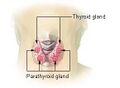 Illustration of thyroid and parathyroid glands
 -
Intermediate magnification of parathyroid gland
-
 Annotated image of oxyphil and chief cells in parathyroid
 -
 3D animation still of hyperparathyroidism
 -
Annotated gross pathology of parathyroid gland
-
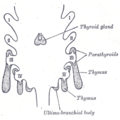 Anatomical illustration of parathyroid gland


Medical Disclaimer: WikiMD is for informational purposes only and is not a substitute for professional medical advice. Content may be inaccurate or outdated and should not be used for diagnosis or treatment. Always consult your healthcare provider for medical decisions. Verify information with trusted sources such as CDC.gov and NIH.gov. By using this site, you agree that WikiMD is not liable for any outcomes related to its content. See full disclaimer.
Credits:Most images are courtesy of Wikimedia commons, and templates, categories Wikipedia, licensed under CC BY SA or similar.
Translate page: - East Asian
中文,
日本,
한국어,
South Asian
हिन्दी,
தமிழ்,
తెలుగు,
Urdu,
ಕನ್ನಡ,
Southeast Asian
Indonesian,
Vietnamese,
Thai,
မြန်မာဘာသာ,
বাংলা
European
español,
Deutsch,
français,
Greek,
português do Brasil,
polski,
română,
русский,
Nederlands,
norsk,
svenska,
suomi,
Italian
Middle Eastern & African
عربى,
Turkish,
Persian,
Hebrew,
Afrikaans,
isiZulu,
Kiswahili,
Other
Bulgarian,
Hungarian,
Czech,
Swedish,
മലയാളം,
मराठी,
ਪੰਜਾਬੀ,
ગુજરાતી,
Portuguese,
Ukrainian


