Furosemide
Furosemide is a prominent member of the loop diuretics class, which are potent therapeutic agents primarily utilized for the management of edematous conditions, congestive heart failure, and occasionally hypertension. Notably, clinical manifestations of acute liver injury attributable to loop diuretics are extraordinarily rare, almost to the point of being nonexistent.
Mechanism of Action[edit]
Loop diuretics, including Furosemide, exert their diuretic action by inhibiting the sodium-potassium-chloride symporter located within the thick ascending limb of the loop of Henle. This inhibition reduces sodium reabsorption, leading to an increased sodium delivery to the distal convoluted tubule. Given that the tubule's capacity to reabsorb this increased sodium is overwhelmed, a rapid excretion of sodium in urine, or sodium diuresis, follows. Although characterized by a shared mechanism of action, loop diuretics are chemically diverse. In terms of potency and duration, they surpass thiazide diuretics, which renders them more suitable for treating edema rather than for prolonged hypertension management. Some shared adverse effects encompass dizziness, headache, gastrointestinal disturbances, hypernatremia, hypokalemia, and dehydration.
FDA Approval[edit]
In the realm of loop diuretics, Furosemide boasts the distinction of being the inaugural agent to receive FDA approval in the United States (1966). Its relevance and ubiquity are underscored by over 37 million annual prescription fillings.
Dosage and Administration[edit]
Furosemide is commercialized in 20, 40, and 80 mg tablets, both as generic offerings and under the Lasix brand name. Apart from tablet formulations, it is procurable as an oral solution and as a liquid for injection purposes. Typically, adults are prescribed daily doses ranging from 20 to 320 mg, which can be split into one to three segments.
Other Loop Diuretics[edit]
- Ethacrynic Acid: Following Furosemide, Ethacrynic acid became the next loop diuretic to gain FDA approval (1967). Though its present-day use has dwindled, it remains accessible in 25 mg tablets and as an intravenous solution, both generically and under the Edecrin brand. The customary adult dose spans between 25 to 100 mg daily, divided into one to three doses.
- Bumetanide: Introduced in the U.S. market in 1983, Bumetanide is a potent loop diuretic mainly prescribed for edema. It can be availed in 0.5, 1, and 2 mg tablets, either generically or branded as Bumex. The standard oral dosage for adults is 0.5 to 2 mg daily, apportioned into two or three doses.
- Torsemide: Gaining U.S. approval in 1993, Torsemide is employed both for edema and hypertension treatment. It comes in 5, 10, 20, and 100 mg tablets, as well as in intravenous solutions, all of which are available generically or under the Demadex brand. Typically, adults are advised to consume 5 to 100 mg daily, either as a single dose or split into two.
| Diuretics (C03) | ||||||||||||||||||||
|---|---|---|---|---|---|---|---|---|---|---|---|---|---|---|---|---|---|---|---|---|
|
-
 Chemical structure of Furosemide
 -
 3D molecular model of Furosemide
 -
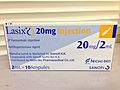 Lasix box 2016
 -
 Furosemide for veterinary use


Sponsored Health Resource

W8MD Weight Loss, Sleep & MedSpa
Looking for physician-supervised weight loss, semaglutide, tirzepatide, or GLP-1 receptor agonist options? W8MD helps eligible patients in New York City, Brooklyn, New Jersey, Connecticut, Pennsylvania, Delaware, and greater Philadelphia with medical weight loss, sleep medicine, and long-term maintenance support.
GLP-1 specials: Affordable GLP-1 injections NYC and Philadelphia starting from $29.99/week and up for semaglutide with insurance accepted for qualifying visits, and $45/week and up for tirzepatide with insurance accepted for qualifying visits. Self-pay options start from $59.99/week and up for semaglutide and $69.99/week and up for tirzepatide.
- Medical weight loss NYC
- Affordable GLP-1 injections NYC
- Budget GLP-1 weight loss shots Philadelphia
- New Jersey medical weight loss
- NYC medical weight loss blog
- Philadelphia weight loss blog
- Sleep medicine and sleep apnea services
- W8MD MedSpa and wellness
Book a W8MD appointment · View GLP-1 specials
Paid promotional message. Eligibility, pricing, insurance coverage, medication availability, and results vary. Medical evaluation required.

Medical Disclaimer: WikiMD is for informational purposes only and is not a substitute for professional medical advice. Content may be inaccurate or outdated and should not be used for diagnosis or treatment. Always consult your healthcare provider for medical decisions. Verify information with trusted sources such as CDC.gov and NIH.gov. By using this site, you agree that WikiMD is not liable for any outcomes related to its content. See full disclaimer.
Credits:Most images are courtesy of Wikimedia commons, and templates, categories Wikipedia, licensed under CC BY SA or similar.
Translate page: - East Asian
中文,
日本,
한국어,
South Asian
हिन्दी,
தமிழ்,
తెలుగు,
Urdu,
ಕನ್ನಡ,
Southeast Asian
Indonesian,
Vietnamese,
Thai,
မြန်မာဘာသာ,
বাংলা
European
español,
Deutsch,
français,
Greek,
português do Brasil,
polski,
română,
русский,
Nederlands,
norsk,
svenska,
suomi,
Italian
Middle Eastern & African
عربى,
Turkish,
Persian,
Hebrew,
Afrikaans,
isiZulu,
Kiswahili,
Other
Bulgarian,
Hungarian,
Czech,
Swedish,
മലയാളം,
मराठी,
ਪੰਜਾਬੀ,
ગુજરાતી,
Portuguese,
Ukrainian

